

Last Updated: November 5, 2026
Quick Summary
Aluminum signs give businesses durable, weather-resistant branding that holds its shape, color, and message far longer than acrylic, wood, or vinyl. They resist water and rust, accept UV-protected or powder-coated finishes, and work as a long-term asset rather than a recurring expense.
- Aluminum does not absorb water the way wood does, which supports its durability outdoors.
- Choose thickness, finish, size, and mounting in that order before ordering custom signs.
- Compare lifecycle cost using purchase price, installation, maintenance, and replacement interval.
- Set a baseline of foot traffic and customer mentions before installing a new sign.
- Buying on price alone often means the thinnest finish, which fades first.
Table of Contents
- Why Aluminum Signs Outperform Other Business Signage Materials
- Durability and Weather Resistance: What Your Sign Will Face Outdoors
- How to Choose the Right Custom Aluminum Signs for Your Brand
- Outdoor Aluminum Signs: Performance in Rain, Heat, and Sun
- Custom Metal Signs for Business: Design and Brand Consistency
- Quantifying the Lifecycle Cost of Aluminum Signage
- Measuring Branding Outcomes from Your Signage Investment
- Common Mistakes Businesses Make with Aluminum Signage
- Choosing Your First Custom Aluminum Sign for Your Business
- Frequently Asked Questions
Why Aluminum Signs Outperform Other Business Signage Materials
Walk down any commercial strip and you can usually tell which signs were installed last year and which ones were installed a decade ago. The difference is almost always the material. Aluminum signs hold their shape, their color, and their message long after acrylic, wood, and vinyl have started to fail, which is why they remain the default choice for businesses that want signage to work as a long-term asset rather than a recurring expense.
The reason comes down to how aluminum behaves. It is a metal that does not rust the way iron does, and it can be printed with graphics that stay readable outdoors when paired with a protective finish.
If you are weighing materials side by side, our durable outdoor sign material guide breaks down how aluminum compares to the alternatives before you commit.
Durability and Weather Resistance: What Your Sign Will Face Outdoors
Durability is one of the main reasons people choose aluminum. Aluminum is a durable metal that does not absorb water the way wood does.
The thickness of the aluminum and the coating on top of it both affect how a sign holds up over time.
Worried specifically about rust? Our answer to whether aluminum signs rust outdoors covers exactly what causes corrosion and how quality finishes prevent it.
How to Choose the Right Custom Aluminum Signs for Your Brand
Choosing custom aluminum signs comes down to matching four variables to your actual use: thickness, finish, size, and mounting.
Here is the order that works in practice:
- Decide indoor or outdoor first. Outdoor use demands UV protection and a corrosion-resistant finish; indoor signs can be thinner and simpler.
- Pick the size for viewing distance. A sign read from across a parking lot needs larger lettering than one read at a counter.
- Choose the finish for the environment. Powder coating and UV-protected printing hold up best where sun and moisture are constant.
- Confirm mounting before you order. Pre-drilled holes and the right hardware prevent installation headaches.
Specifications That Actually Matter
| Specification | Why It Matters | What to Prioritize |
|---|---|---|
| Panel thickness | Resists denting and flexing | Thicker for large or outdoor panels |
| Finish / coating | Protects against UV and moisture | UV-protected or powder-coated |
| Corner style | Affects safety and appearance | Rounded corners for high-traffic areas |
| Mounting holes | Determines installation ease | Pre-drilled holes matched to hardware |
| Print method | Controls color sharpness and life | Sublimated or high-resolution printing |
Outdoor Aluminum Signs: Performance in Rain, Heat, and Sun
Outdoor aluminum signs are often paired with a protective finish, since moisture, heat, and ultraviolet light can all wear down coatings over time.
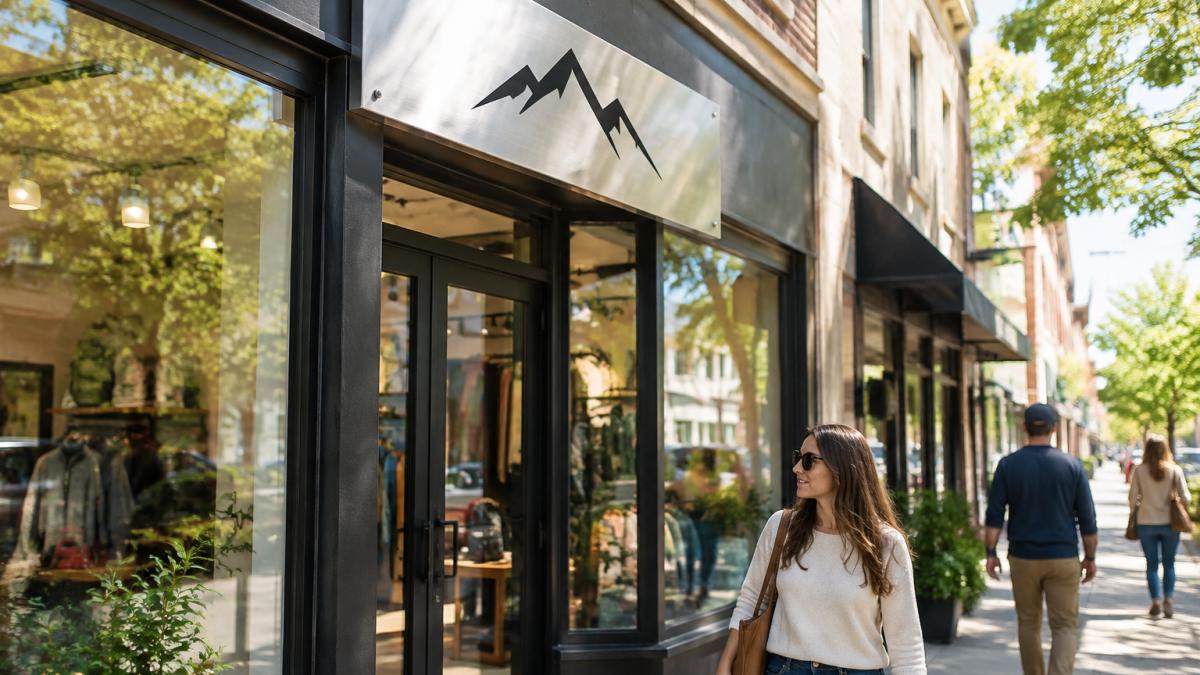
For long-term outdoor installations, our guide to preventing corrosion on outdoor aluminum displays walks through the maintenance habits that extend service life.
Custom Metal Signs for Business: Design and Brand Consistency
Brand consistency is where signage earns its keep, and it is where most businesses leave value on the table. A custom metal sign is not just a label on a wall; it is a repeated visual cue that trains customers to recognize your colors, your logo, and your personality before they read a single word.
A common mistake is treating each sign as a one-off design project. Your storefront sign, your wayfinding signs, and your interior promotional signage should share a single visual system: the same logo treatment, the same color matching, and the same typographic hierarchy. When they do, every touchpoint reinforces brand image instead of fragmenting it.
A few design rules that hold up:
- Lock your colors. Match Pantone or brand hex values across every sign so nothing drifts.
- Keep the logo legible at distance. Simplify detail that disappears when scaled down.
- Design for the environment. High-contrast graphics read better outdoors in glare.
- Repeat one signature element. A consistent border, shape, or tagline ties the set together.
Quantifying the Lifecycle Cost of Aluminum Signage
Cost-effectiveness is not the same as the lowest sticker price. The real number to compare is lifecycle cost: what you pay upfront plus what you spend replacing, repairing, and reprinting over the years the sign is in service. A cheaper sign that needs replacing twice costs more than a durable one bought once.
To make that comparison honestly, you need four inputs for each material option: purchase price, installation cost, annual maintenance cost, and expected service life. Most buyers only look at the first number, which is why vinyl banners and thin acrylic panels often appear cheaper on paper but lose over time.
Here is a simple framework you can apply to any quote:
- Purchase price, the quoted cost of the panel and graphics.
- Installation cost, hardware, labor, and any wall or post preparation.
- Annual maintenance, cleaning, touch-ups, and hardware checks.
- Replacement interval, how many years before the sign must be reprinted or replaced.
Divide total spend by years of service to get an annualized cost.
A common pattern practitioners see is that the cheapest option wins on year one and loses by year three. That is the point where replacement labor, downtime, and repeated design setup erase the upfront savings. If you are weighing the two, our comparison of budget printing versus custom aluminum quality lays out where the savings disappear over time.
Watch out: comparing quotes without confirming what each includes, hardware, installation, and design setup, can make a cheaper sign look more expensive than it is, or vice versa.
Measuring Branding Outcomes from Your Signage Investment
Return on investment from signage is measurable if you set it up to be measured. The mistake is installing a sign and never checking whether it did anything. A few simple tracking habits turn signage from a guess into a decision you can defend.
Start by setting a baseline before the new sign goes up. Record what you can observe directly for two to four weeks: daily foot traffic counts, the number of directional questions staff field, and how new customers say they found you. That baseline is what you compare against after installation.
Then track these signals:
- Foot traffic changes after a storefront refresh, counted with a simple door counter or a manual tally at the same times each day.
- Customer mentions of the sign in reviews, comment cards, or front-desk conversations, logged in a shared spreadsheet.
- Directional success, measured by whether people stop asking where a department or entrance is.
- Brand recall, tested by asking new customers how they found you and whether they noticed the sign before walking in.
None of this requires expensive analytics. It requires deciding in advance what "working" looks like, then watching for it.
Watch out: changing the sign and a promotion at the same time makes it impossible to attribute any traffic lift to the sign alone, so stagger the changes if you want a clean read.
Common Mistakes Businesses Make with Aluminum Signage
The most common mistakes with aluminum signage are avoidable, and they usually trace back to skipping the specification stage or treating design as an afterthought. Watch out for these, because each one quietly shortens the sign's useful life or weakens its branding impact.
- Buying on price alone. The cheapest panel often has the thinnest finish, which fades first.
- Ignoring viewing distance. Lettering sized for a counter gets lost on a building exterior.
- Mismatched colors across signs. Inconsistent color matching erodes brand recognition.
- Skipping UV protection outdoors. Unprotected graphics bleach faster than expected.
- Poor mounting choices. Wrong hardware causes sagging, rattling, or wall damage.
- No maintenance plan. A quick seasonal wipe-down prevents most long-term corrosion.
Getting these right is not complicated, but it does require deciding them before you order rather than after the sign arrives.
Choosing Your First Custom Aluminum Sign for Your Business
Your first custom aluminum sign should match the job it has to do, not the biggest design you can afford. Start with the highest-visibility location, choose a finish rated for that environment, and confirm the mounting method before you buy. Then expand into secondary signs once the first one proves itself.
A simple decision path helps:
- Storefront or exterior? Prioritize thickness, UV protection, and weather resistance.
- Interior branding? Focus on color matching and visual consistency with your exterior.
- Wayfinding or directional? Keep graphics simple and legible at a glance.
- Promotional or temporary? Choose a reusable panel you can repurpose.
If you want a vetted starting point, our roundup of the best custom aluminum sign providers is a practical place to compare options before you commit.
Signage is one of the few branding investments that works every single day without maintenance or attention. At Real Cool Signs, we build aluminum signs around the things people are proud to show: durable aluminum construction, a wide variety of themes, free standard shipping on orders over $99, and an easy 30-day return policy. Get started with Real Cool Signs and turn your brand, your passion, or your favorite place into something worth displaying. 🎯 SHOP OUR REAL COOL COLLECTIONS NOW
Frequently Asked Questions
How long does an aluminum sign last?
Most aluminum signs last well over a decade when properly maintained. The metal itself resists rust and corrosion, and UV-protected finishes keep graphics from fading in direct sunlight. Signs mounted outdoors in harsh conditions may need occasional cleaning, but the underlying aluminum panel typically holds up for 10 to 15 years or more. Longevity depends on the thickness of the aluminum, the quality of the coating, and how much direct sun and moisture the sign faces.
Is aluminum good for outdoor signs?
Yes. Aluminum is one of the best materials for outdoor aluminum signs because it resists rust, handles temperature swings, and stays lightweight enough to mount without heavy hardware. It does not warp or crack like wood, and it holds printed graphics well when paired with a protective coating. For storefronts, wayfinding, and promotional signage exposed to rain or sun, aluminum delivers reliable performance year after year.
How do aluminum signs compare with other business sign materials?
Aluminum outperforms acrylic, wood, and vinyl in durability and weather resistance. Acrylic can crack under impact, wood rots and warps, and vinyl fades faster in direct sun. Aluminum stays rigid, resists corrosion, and holds color longer. The trade-off is a higher upfront cost, but the longer service life and lower replacement costs usually make aluminum the more cost-effective choice over five to ten years.
What should businesses consider when designing an aluminum sign?
Start with brand consistency: match your logo colors, fonts, and tone across every sign. Choose a size that fits the viewing distance, and pick a finish that suits the environment, such as UV-protected coating for outdoor aluminum signs. Keep text short and high-contrast so it reads from a distance. Finally, confirm the mounting method works for your wall or post before you order.
