


Last Updated: October 30, 2026
Quick Summary
Custom metal signs can be worth it for business offices because they look durable and established, and they hold up to daily wear. Aluminum is the practical choice for most indoor walls since it is light, does not rust, and holds detailed printed graphics.
- Metal signs look like they were built to last, creating a strong first impression at reception.
- Aluminum is light enough for one person to hang a mid-size panel without special hardware.
- Steel, brass, and copper are heavier and may need sturdier anchors before hanging on a wall.
- Read a sign from about one inch of letter height for every ten feet of viewing distance.
- Avoid drilling in leased space when possible, since every hole can become a repair bill at move-out.
Table of Contents
- Why Metal Signs Stand Out in an Office Setting
- Comparing Metal Materials: Aluminum, Steel, Brass, and Copper
- Custom Shapes, Sizes, and Logo Personalization
- Finishes, Colors, and Printing or Engraving Options
- Choosing Custom Aluminum Office Signs for Indoor Use
- Placement, Sizing, and Mounting in Reception Areas and Walls
- Total Cost Factors and What the Price Includes
- Using Office Signs for Workplace Wayfinding and Readability
- Ordering Your Office Sign and Picking the Right Design
- Frequently Asked Questions
Why Metal Signs Stand Out in an Office Setting
Custom metal signs for business office decor do something a printed poster never can: they look like they were built to last. A solid aluminum panel on a reception wall signals that the company is established and cares about details. Readers comparing materials can see how engraved and printed finishes compare in perceived value. That first impression matters before a single word is read.
Metal also holds up to daily wear. Office walls take bumps from carts, chairs, and passing traffic, and a sturdy sign shrugs them off. Real Cool Signs builds its signs from durable aluminum.
There is a lighter side too. An office sign can carry personality. A funny warning-style sign in a break room or manager's office tells visitors and staff something about the culture without a single memo.
Comparing Metal Materials: Aluminum, Steel, Brass, and Copper
Most custom sign catalogs list four or five metals and leave the buyer to guess which one belongs on an office wall. The trade-offs are real, and they show up in weight, finish, upkeep, and how the graphics are applied. Here is how the common options actually differ.
Aluminum is the workhorse of indoor office signage. It is light enough that a single person can hang a mid-size panel without special hardware, it does not rust, and it accepts printed graphics with fine detail. A thin aluminum panel stays flat across a large face, which is why it holds crisp lettering and clean logo edges. The trade-off is feel: aluminum reads as modern and practical rather than luxurious, and a bare-metal edge can look utilitarian next to wood or brass trim.
Steel is heavier and carries an industrial character that suits workshops, breweries, and offices with an exposed-brick or warehouse aesthetic. The weight is the catch. A steel panel of the same footprint as an aluminum one can be several times heavier, which changes what mounting hardware you need and raises the risk of pulling drywall anchors out over time. Bare steel also wants a protective coating indoors to keep fingerprints and humidity from leaving marks.
Brass brings a warm, traditional look that reads as established and formal. It is a common choice for law firms, financial offices, and executive suites where the sign is meant to feel like a fixture rather than a poster. Brass is heavier than aluminum and, depending on the alloy and finish, can develop a patina over time. You can see how a vintage brass instrument identification sign is presented as an example of brass signage. Some offices want that aged look; others want it polished, which means periodic care.
Copper is the most distinctive of the group, with a reddish tone that deepens as it ages. It suits boutique offices, studios, and spaces with a designed interior. Like brass, it is heavier than aluminum and asks for occasional attention if you want to keep a bright finish rather than a weathered one.
A quick way to think about the choice:
- Weight and hanging ease: aluminum is the lightest and simplest to mount; steel, brass, and copper are heavier and may need sturdier anchors.
- Finish character: aluminum reads modern and clean; steel reads industrial; brass and copper read traditional and premium.
- Upkeep: aluminum needs little beyond a wipe; brass and copper may need polishing to hold a bright finish.
- Graphic detail: printed aluminum handles fine text and full-color artwork well; engraved metals trade some color range for a tactile, premium surface.
For most indoor office walls, aluminum hits the practical middle: light, rust-resistant, and capable of holding detailed printed graphics. If the room calls for a traditional finish and the wall can carry the extra weight, brass or copper earns its place. The right move is to match the metal to the wall and the room before matching it to a mood board.
Custom Shapes, Sizes, and Logo Personalization
Real Cool Signs offers some of its designs in two sizes, 8" x 12" and 12" x 18". A small sign suits a cubicle wall or a door. The larger size suits a break room or conference room where people stand back to read.
Finishes, Colors, and Printing or Engraving Options
The bold orange, black, and white warning-sign style used across the Real Cool Signs funny office collection is a good example of how a high-contrast color scheme makes a message readable at a glance.
Choosing Custom Aluminum Office Signs for Indoor Use
Aluminum is a common fit for indoor office use because it is relatively light.
One caution: an indoor sign should still match the room. A sign that is too loud for a formal lobby can undercut the professional image you want, so pick a design that suits the setting.
Placement, Sizing, and Mounting in Reception Areas and Walls
Placement is where most office signs succeed or fail, and it comes down to three things: how far away people will stand, what the wall is made of, and how the sign will be attached. Get those right and the sign reads cleanly from day one.
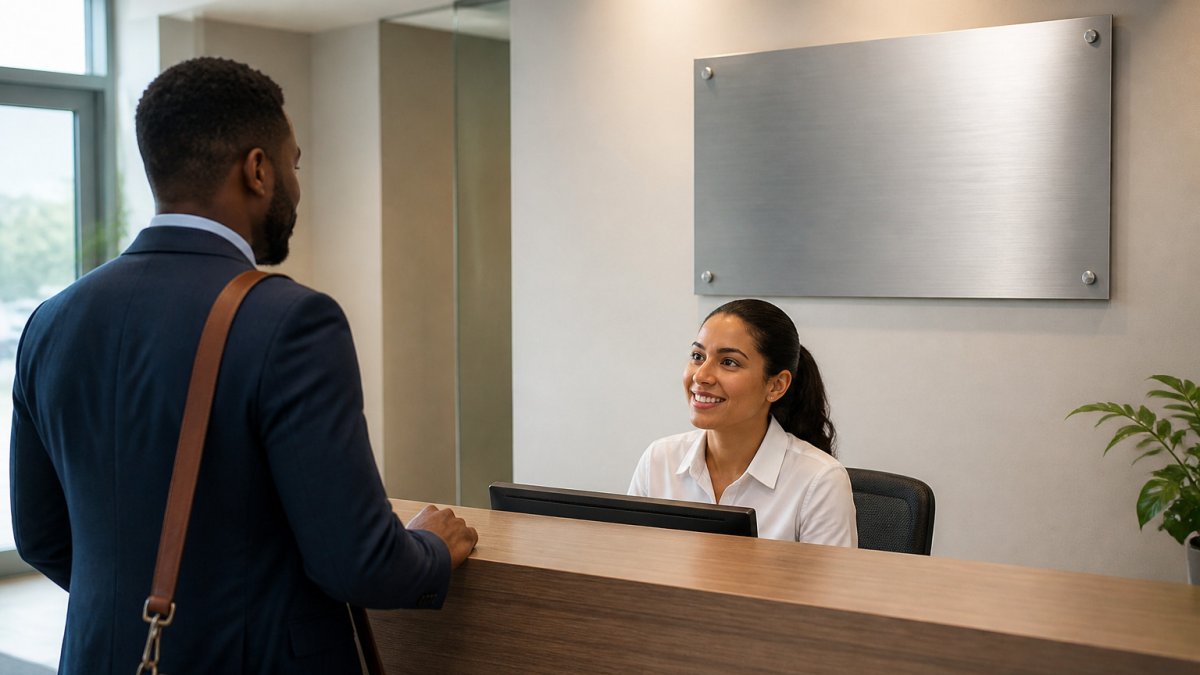
Start with viewing distance. A useful rule of thumb in signage work is roughly one inch of letter height for every ten feet of viewing distance. A sign read from a reception desk a few feet away can carry smaller text; a sign meant to be read from across a lobby or down a hallway needs larger lettering and a simpler message. Before you pick a size, stand where visitors will actually stand and look at the wall. For more on wall-mounted metal decor in workplaces, see our guide to metal signs for shop walls.
Match the size to the wall, not the other way around. A small panel on a large blank wall looks lost, and an oversized panel in a narrow hallway feels cramped. Leave generous breathing room around the sign, and if the wall is large, consider grouping the sign with other décor rather than stretching one piece to fill the space. For a reception area, centering the sign above or beside the desk at eye level keeps it in the visitor's natural line of sight.
Danger Multitasking in Progress Sign – Funny Office & Workplace Aluminum Sign →
Know your wall type before you buy hardware. Office walls are not all the same, and the anchor matters as much as the sign:
- Drywall over wood studs: the most forgiving surface. Use wall anchors rated for the sign's weight, or drive screws into studs where possible.
- Drywall with no stud behind the spot: use expanding anchors sized to the load. Heavier metal panels need heavier anchors.
- Concrete or masonry: requires a masonry bit and sleeve anchors; a standard drywall anchor will not hold.
- Glass partitions and demountable walls: avoid drilling. Adhesive mounting or a freestanding display is usually the safer route in leased space.
- Fabric-covered panels and cubicle walls: pin or clip mounting works better than screws.
Level it before you walk away. Mark the mounting points with a pencil and a level, drill pilot holes, and check the sign with a level again after hanging. For a two-person job, have one person hold the panel while the other confirms placement before the final tighten.
Plan for layout changes. Offices rearrange. A sign hung with removable adhesive strips or a single well-placed anchor is easier to relocate than one bolted through four holes. If the sign is likely to move with a team or a desk, choose a mounting method that travels with it.
A common pattern in offices that get this right: they pick the wall first, measure the viewing distance second, and choose the sign size and mounting hardware last. That order keeps the sign readable, the wall intact, and the installation a one-afternoon job rather than a facilities ticket.
Before choosing a size or hardware, match the sign to how far people will stand from it and what the wall is made of.
| Wall type | Mounting approach | Note |
|---|---|---|
| Drywall over wood studs | Wall anchors rated for the weight, or screws into studs | The most forgiving surface |
| Drywall, no stud behind spot | Expanding anchors sized to the load | Heavier panels need heavier anchors |
| Concrete or masonry | Masonry bit and sleeve anchors | Standard drywall anchors will not hold |
| Glass partitions, demountable walls | Adhesive mounting or freestanding display | Avoid drilling in leased space |
| Fabric-covered panels, cubicle walls | Pin or clip mounting | Works better than screws |
Total Cost Factors and What the Price Includes
The sticker price is only part of the cost. Consider the size, the number of signs, shipping, and any future replacements. A single sign for a manager's office costs far less than a full set for a reception area and conference rooms.
Real Cool Signs lists its funny office aluminum signs at $27.99 each. The brand offers free shipping on orders over $99 and an easy 30-day return policy.
Using Office Signs for Workplace Wayfinding and Readability
A sign does more than decorate. In a busy office, clear signage helps people find their way and understand the space. Readability depends on size, contrast, and placement, so a sign must be easy to see from the distance it will be read.
High-contrast designs work best. Dark text on a light background, or the bold orange, black, and white combination, stands out in a hallway. Keep the wording short so the message registers in a glance.
For a lighter touch, a sign like the Danger Multitasking in Progress design can add personality to a workspace.
Ordering Your Office Sign and Picking the Right Design
Start by deciding where the sign will hang and how large it should be. Then choose a theme that suits the room. A reception area calls for a clean, professional message, while a break room or home office can carry humor.
Here is a simple way to narrow the choice:
- Break room or manager's office: a funny office sign for personality
Explore the full funny office sign selection at Real Cool Signs, where the Danger Multitasking in Progress, Beware Technical Support Rage Zone, I'm Not Arguing I'm Explaining Why I'm Right, This Meeting Could Have Been an Email, and Do Not Mistake My Silence for Agreement signs each sell for $27.99. Pick the one that fits your space and let it start the conversation.
Frequently Asked Questions
What types of custom metal signs work well in a business office?
Office signs can range from wall plaques to door signs. Real Cool Signs offers aluminum designs such as the Danger Multitasking in Progress Sign and This Meeting Could Have Been an Email Sign, priced at $27.99, which show how a bold warning-sign style can add personality to a break room or manager's office.
Which metal is best for an indoor office sign?
Aluminum is a practical choice for many indoor offices because it is relatively lightweight. Steel is heavier and suits a more industrial look, while brass and copper give a warmer, traditional finish but cost more and show wear differently. The Real Cool Signs designs listed here are made from .32 mm aluminum and sell for $27.99 in 8 x 12 inch and 12 x 18 inch sizes, which suits lighter wall decor in a home office or break room.
Are aluminum signs suitable for indoor office decor?
Yes. Aluminum signs are well suited to indoor office use because they are lightweight, simple to mount and resistant to rust. Real Cool Signs' aluminum designs are made from durable aluminum. Choose a size that matches the wall and viewing distance, and mount the sign at eye level near the entrance or meeting room it serves.
What should you include on a business office sign?
Keep the text short and readable from a distance. Include the business name or logo first, then a single line of supporting text if needed, such as a department name or a short message. Avoid long paragraphs, because visitors scan a sign for a second or two. A funny or personal message can suit a shared office, while a reception or client-facing sign usually works best with a plain, legible layout and a limited number of colors.
Your office is where you spend much of your working life, so it should feel like yours. Custom aluminum signs help you bring a bit of personality, clarity, and pride into the space. Find the design that tells your story at Real Cool Signs.
