


Last Updated: November 1, 2026
Quick Summary
Personalized aluminum signs for weddings work best when the wording is short, names and the date are clear, and the material suits the setting. Aluminum is light, holds fine text and monograms, and can move from the reception to a living room afterward.
- Keep wedding sign text to a few words so it reads from across the room.
- Aluminum is light enough to move, resists rust outdoors, and holds fine detail.
- Wood can warp with humidity, and acrylic scratches with handling.
- Order eight to ten weeks before the wedding and approve the proof line by line.
Table of Contents
- Why Couples Choose Personalized Aluminum Signs for the Big Day
- Wedding Sign Wording Ideas That Hold Up Over Time
- Aluminum Versus Other Materials for Wedding Signage
- Choosing the Right Size and Layout for Your Venue
- Aluminum Wedding Welcome Sign Essentials
- Wedding Seating Chart Sign Options
- DIY Wedding Signage Versus Ordering Custom Pieces
- Ordering Timeline, Proofing, and Delivery Planning
- Keeping Your Wedding Sign as a Lasting Keepsake
- Frequently Asked Questions
- Choose the Sign That Tells Your Story Together
Why Couples Choose Personalized Aluminum Signs for the Big Day
At Real Cool Signs, we see the same pattern every wedding season: couples want a piece of their love story on display long after the cake is gone. Personalized aluminum signs make that possible. Choosing personalized aluminum signs for a wedding is about more than decoration. It is a way to mark names, dates, and a shared sense of humor in a form that will last.
Aluminum has a clean, modern look that suits both rustic barns and polished ballrooms. It takes custom text, monograms, and photos well, so the sign can match the tone of the event. Couples also value that the piece can move from the reception to the living room afterward.
Below, we cover the wording, materials, sizing, and ordering steps that help you get it right the first time.
Wedding Sign Wording Ideas That Hold Up Over Time
The best wording is short enough to read from across a room and personal enough to mean something years later. Names and the wedding date are the most common choices, and they age well because they do not depend on a trend.
Common options include:
- Names and date, such as "Sarah & James | June 14"
- A single family name, such as "The Carters"
- A short line from a favorite song or a shared joke
- A monogram paired with the year the couple met
Keep the text to a few words where possible. Long quotes look crowded on a welcome sign and get harder to read as the sign gets farther from the viewer.
Aluminum Versus Other Materials for Wedding Signage
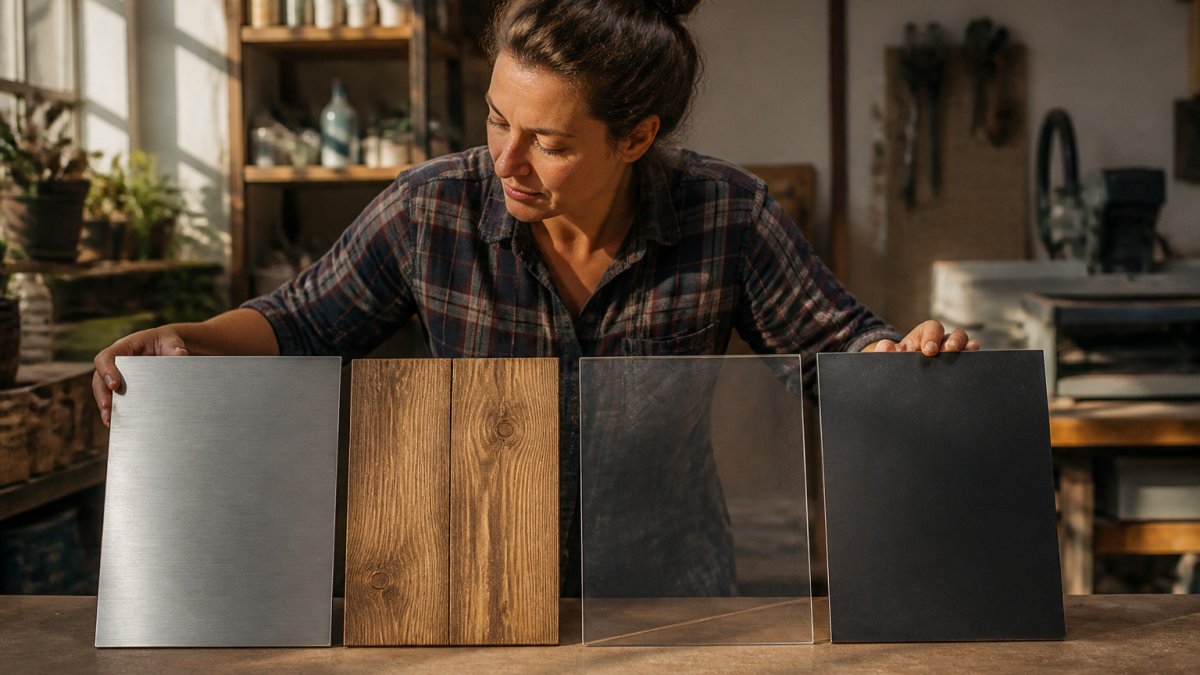
Most wedding-sign roundups lump every metal into one bucket and move on. That is a mistake, because the material you choose decides how the sign reads in photos, how it survives an outdoor ceremony, and whether it is still hanging on a wall ten anniversaries from now. Here is how the common options actually compare when the reception ends and real life begins.
Aluminum
A large welcome sign that has to be carried to a venue, propped on an easel, and later hung on a living-room wall is easier to handle when it is lighter, and the wording and sizing choices below matter more than the metal itself.
For a sign that will be photographed up close, a seating chart, a signature-drink menu, clean, crisp lettering makes a real difference.
Wood
Wood is the warm, rustic choice and photographs beautifully in barn and vineyard settings. The trade-off is movement. Solid wood expands and contracts with humidity, so a sign that looks flat in a dry hall can cup or develop hairline cracks after a damp outdoor ceremony. Painted lettering on wood also tends to soften at the edges over time. Wood works well for a single-day display; it is a riskier bet as a decades-long keepsake unless it is sealed and kept indoors.
Acrylic
Acrylic, often sold as clear or frosted "acrylic glass", gives a modern, floating look and is popular for welcome signs and table numbers. It is lightweight and shatter-resistant compared with actual glass, but the surface scratches. A sign that gets wiped down, stacked in a car, or leaned against a wall between events will pick up fine scuffs that catch the light. Acrylic is a strong pick for a sleek indoor reception and a weaker one for anything that will be handled roughly or displayed outside.
Steel
Steel is the heaviest option and carries an industrial, architectural feel. It is durable, but weight becomes a practical problem: hanging a large steel sign safely usually means finding a stud or using heavy-duty hardware, and moving it is a two-person job. Bare steel can rust if moisture reaches it, so a coated finish matters. Steel suits a modern, moody design scheme; it is overkill for a sign that will live above a sofa.
The Practical Comparison
| Material | Weight | Weather behavior | Finish detail | Best use |
|---|---|---|---|---|
| Aluminum | Light | Resists rust; needs a quality finish outdoors | Holds fine text and thin lines | Indoor or outdoor, day-of and keepsake |
| Wood | Medium | Can warp or crack with humidity | Softer painted edges over time | Rustic indoor display |
| Acrylic | Light | Fine indoors; scratches with handling | Crisp but scuff-prone | Sleek indoor reception |
| Steel | Heavy | Rusts if moisture reaches bare metal | Durable, industrial look | Statement indoor piece |
How to Decide
Ask three questions before you commit. First, will the sign be outdoors for any part of the day? If yes, prioritize a material that will not rust or warp. Second, will it be handled, carried, stored, re-hung, or will it go straight from the venue to a wall? Handling favors lighter, scratch-resistant surfaces. Third, how close will the camera get? Fine lettering and monograms reward a material that holds detail.
For most couples, aluminum is the material that answers all three without a compromise: light enough to move, stable enough to display outside for an afternoon, detailed enough for a monogram, and durable enough to become the piece that hangs in the entryway for the next twenty years. For a closer look at how it holds up outdoors, see whether aluminum signs rust outdoors. That is why it shows up so often in personalized wedding decor, not because it is trendy, but because it is the material that keeps working after the wedding does.
Choosing the Right Size and Layout for Your Venue
Size should match the space and the viewing distance. A welcome sign at a building entrance can be larger than a table sign, which is meant to be read at arm's length. Measure the wall or easel space before you order, and allow room for the sign's mounting method.
Consider layout too. A horizontal sign fits a long wall, while a vertical sign suits a narrow hallway or an entryway. Keep margins generous so the text does not feel cramped against the edges.
Aluminum Wedding Welcome Sign Essentials
A welcome sign sets the tone for guests as they arrive, so it should be clear, legible, and placed where people will pause to read it. Place it at eye level near the entrance, not behind a planter or a door that swings across it.
Focus on three things: readable text, a finish that suits the venue lighting, and a mounting or stand plan that is settled before the day. Test the sign's placement with a dry run so you know the angle and height work.
Wedding Seating Chart Sign Options
Seating charts are often the most-photographed sign at a reception, so they deserve careful planning. Many couples choose a large board that lists table numbers and names. Others prefer a sign with a single line directing guests to a separate printed list.
Whatever you choose, make sure the layout is easy to scan. Alphabetical order by last name is the most familiar format, and consistent spacing keeps the list from looking busy.
DIY Wedding Signage Versus Ordering Custom Pieces
Some couples prefer to make their own signs, and that can work well for simple wording and a small guest list. Hand-lettered or printed paper signs cost little and allow flexibility. The trade-off is durability and finish. Paper signs tend to bend, fade, or peel, and they rarely survive as keepsakes.
Custom aluminum pieces offer the ability to keep the sign afterward. If the sign is meant to be a lasting memento, ordering a custom piece is usually the better choice. Compare the effort, budget, and how long you want the sign to last before deciding.
Ordering Timeline, Proofing, and Delivery Planning
A wedding date does not move, which makes a custom sign one of the few wedding purchases where a late shipment cannot be fixed with an apology. The couples who end up stressed are almost never the ones who ordered too late, they are the ones who approved a proof without reading it line by line. This section is the practical checklist that keeps both problems from happening.
Work Backward From the Date
Build your timeline backward from the ceremony, not forward from the day you start shopping. A realistic sequence looks like this:
- Eight to ten weeks out: Decide on wording, size, and material. This is when you settle names, date format, and whether the sign is a day-of display, a keepsake, or both.
- Six to eight weeks out: Place the order and submit your text and any artwork. Custom production slots fill up in peak wedding season, so earlier is safer.
- Four to six weeks out: Receive and approve the proof. Do not approve until every detail is confirmed.
- Three to four weeks out: The sign goes into production. Changes after this point are usually difficult or impossible.
- Two weeks out: The sign ships. Build in a buffer for carrier delays rather than assuming the estimated date is guaranteed.
- One week out: The sign is in hand, inspected, and test-mounted at the venue or at home.
If your date falls in a busy season, add a week to every stage. The buffer costs nothing; a missed sign costs the photos.
The Proofing Checklist
The proof is your last clean chance to catch an error. Read it out loud, then read it again against this list:
- Names: Spell every name exactly as it should appear, including middle names, nicknames, and any accents or punctuation.
- Date format: Confirm the order, month/day/year versus day/month/year, and that the year is correct. This is the single most common proofing mistake.
- Ampersands and symbols: Check that "&" versus "and" and any monogram letters are in the order you intend.
- Line breaks: Make sure the text breaks where you want it to, not where the software decided.
- Capitalization: Confirm whether the design uses all caps, title case, or a mix, and that it is consistent.
- Artwork and monograms: If you supplied a monogram or graphic, verify the orientation and that no letter is reversed.
- Layout and margins: Check that text is not crowding the edge and that the visual balance matches what you pictured.
Have a second person, ideally someone who is not emotionally invested in the wedding, read the proof cold. Fresh eyes catch the typo the couple has been staring past for weeks.
Day-Of Display Versus Keepsake: Plan Both Now
Decide before you order whether the sign is primarily a ceremony piece, a reception piece, or a keepsake, because that choice affects size, finish, and mounting. A large welcome sign that greets guests at the entrance is read from a distance and needs bold, simple text. A seating chart is read up close and needs a clean, scannable layout. A sign destined for the living room afterward should be sized for the wall it will actually hang on, measure that wall before you order, not after.
If the sign will do double duty, plan the transition. A welcome sign that later hangs in an entryway works well; a giant seating chart often does not. Couples who think this through end up with a piece they genuinely want to display, rather than one that goes into a closet because it does not fit anywhere.
Confirm Delivery and Mounting Before the Day
Ask when the sign will ship and whether tracking is provided, then confirm who will be available to receive it. If the sign is shipping to a venue or planner, confirm the address and receiving hours in advance. Finally, settle the mounting plan early: know whether the sign will hang, lean on an easel, or stand freestanding, and have the hardware or stand ready before the wedding week. A dry run at the venue, even a quick one, tells you whether the height, angle, and lighting actually work.
Keeping Your Wedding Sign as a Lasting Keepsake
After the wedding, the sign can move into your home. Keep it clean with a soft, damp cloth, and check the mounting hardware periodically.
Many couples hang the sign in a hallway, bedroom, or entry to mark the start of their marriage. It becomes a conversation piece for guests and a reminder of the day for the two of you.
Frequently Asked Questions
What should you look for in a personalized aluminum wedding sign?
Check that the names, date, and wording are correct and that the design fits the venue style. Keep the wording short so it stays readable. Comparing the details side by side makes it easier to choose a sign that will still look good years after the wedding.
What size should a wedding welcome sign be?
Size depends on where the sign will hang and how far guests will stand from it. A small sign works for a table or easel, while a larger piece suits an entry or ceremony backdrop. Measure the space first, then consider how much text needs to be readable at a few feet. Keep the wording short so the sign stays clear at any size you choose.
Can aluminum wedding signs be used outdoors?
Mounting and placement matter, and a sign that will sit in direct sun or rain for hours should be secured properly. Ask the provider about outdoor suitability before you order for an outdoor ceremony.
How far in advance should you order custom wedding signage?
Order custom pieces early enough to allow for shipping, and confirm delivery dates with the seller before the event.
Choose the Sign That Tells Your Story Together
Your wedding is a story you and your partner are writing together, and the right sign can carry a piece of it forward. A personalized aluminum sign gives you a durable, stylish way to celebrate names, dates, and the moments that matter most. Real Cool Signs makes it easy to design a piece that fits your venue and your style, so you can focus on the celebration. Explore the collection at Real Cool Signs and find the design that feels like you.
