


Table of Contents
- Why Aluminum Coasters Beat Wood, Stone, and Cork
- Best Materials for Bar Coasters: What Actually Holds Up
- 7 Custom Aluminum Coasters for Bar Decor Worth Buying
- Custom Metal Signs for Home Bar: Pairing Coasters with Wall Decor
- Engraving vs. Printing: Which Customization Lasts Longer?
- Cleaning and Longevity: Keeping Aluminum Coasters Looking New
- Conclusion
- Frequently Asked Questions
Last Updated: September 11, 2026
Why Aluminum Coasters Beat Wood, Stone, and Cork
Custom aluminum coasters for bar decor solve a problem wood, stone, and cork can't: they survive a wet glass, a hot mug, and a decade of use without warping, cracking, or growing mold.
Wood swells and stains, stone chips, and cork absorbs every drop and starts to smell. Aluminum wipes clean and holds its finish.
The coaster is the cheapest part of your bar and the one that protects everything else. Choose wrong and you're refinishing a walnut countertop.
Below: how the materials compare, what holds up, and seven custom aluminum coasters for bar decor worth buying.
Best Materials for Bar Coasters: What Actually Holds Up
Aluminum is the best material for bar coasters if you want a durable, heat-resistant, scratch-resistant surface that survives condensation night after night. Wood, stone, and cork each have a place, but none handle moisture and heat like metal.
Here's how the four common coaster materials stack up:
| Material | Handles Condensation | Heat Resistance | Maintenance | Best For |
|---|---|---|---|---|
| Aluminum | Excellent | High | Wipe clean | Daily use, outdoor bars |
| Wood | Poor | Moderate | Oil regularly | Rustic display pieces |
| Stone | Good | High | Avoid drops | Weighted, upscale look |
| Cork | Poor | Low | Replace often | Disposable event favors |
The trade-off with aluminum is weight: a thin metal coaster can slide on a smooth bar top, so a non-slip backing or thicker gauge matters more than most buyers realize.
7 Custom Aluminum Coasters for Bar Decor Worth Buying
The best custom aluminum coasters for bar decor pair a durable metal base with a design that matches your space. Every piece below is sublimation-printed on smooth aluminum with extra UV protection.
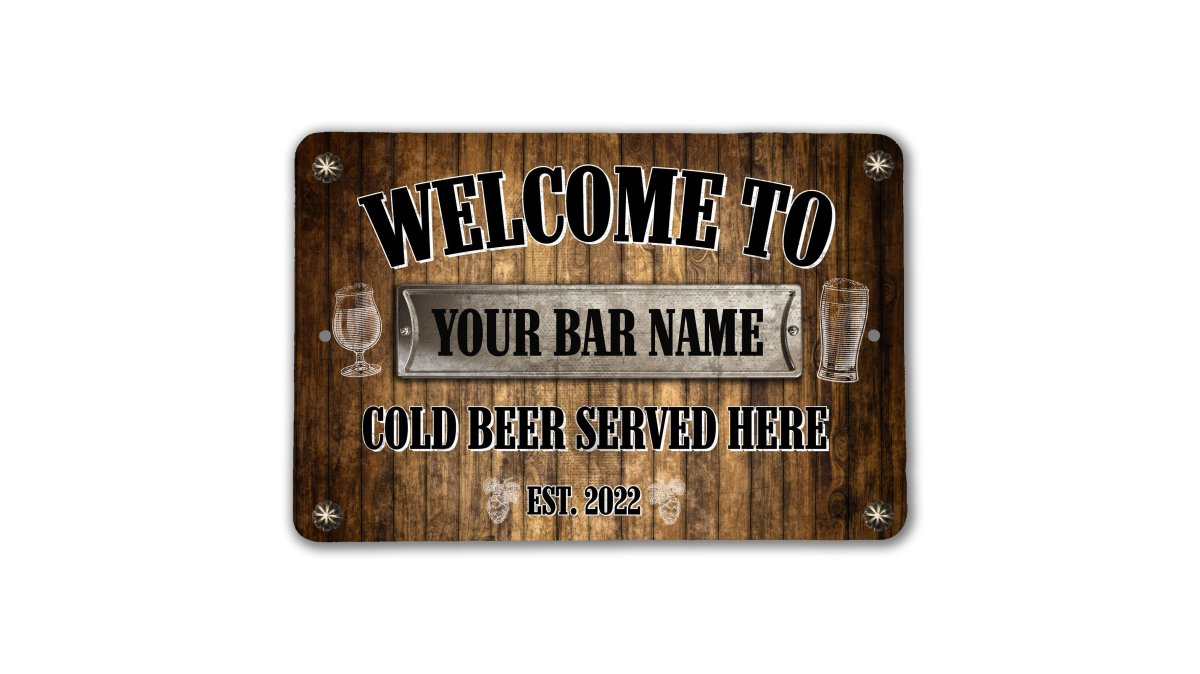
These wall signs anchor a bar wall and double as the design reference for a matching coaster set.
1. Personalized Bar Sign
Our top pick for almost any home bar wall. Custom-made with your name or text, sublimation-printed on smooth aluminum with extra UV protection. Available in 8" x 12" and 12" x 18". Grab it here: Personalized Bar Sign.

2. Personalized Beer Sign
The beer sign gets the most comments at poker night. Personalize it with a name, established date, or slogan for classic pub vibe in a garage or basement bar.
Durable aluminum. Two sizes: 8" x 12" and 12" x 18". See it here: Personalized Beer Sign.

3. Custom Wine Bar Sign
For a wine-focused setup, this beats a generic bar sign, a conversation starter rather than wall filler.
Material is aluminum with a sublimated graphic. Two sizes: 12" x 8" and 18" x 12". Details here: Custom Wine Bar Sign.

4. Personalized Pool Bar Sign
For an outdoor pool bar, this is the one: same aluminum construction and sublimated graphic, with a swim-up theme.
Sizes run 12" x 8" and 18" x 12". Check it out: Personalized Pool Bar Sign.
5. Personalized Cola Sign
Not every bar is a whiskey bar. The cola sign covers the soda-and-mixer crowd, personalized with your name, established date, or slogan.
Heavy-duty 0.32mm aluminum. Sizes: 8" x 12" and 12" x 18". Find it here: Personalized Cola Sign.
6. Personalized Tiki Bar Sign
The most fun piece in the lineup: a retro tropical design with coconut cocktails and hibiscus flowers, plus your custom name above "BAR."
Made from durable .32mm aluminum, available in 8" x 12" and 12" x 18". Get it here: Personalized Tiki Bar Sign.
7. Long Island Iced Tea Recipe Bar Sign
The recipe sign is for anyone who actually mixes drinks, showing exact Long Island Iced Tea proportions sublimation-printed into high-grade aluminum so the graphic won't peel or fade.
Available in 8" x 12" and 12" x 18". See it here: Long Island Iced Tea Recipe Bar Sign.
Custom Metal Signs for Home Bar: Pairing Coasters with Wall Decor
Custom metal signs for home bar setups work best when the coaster design echoes the wall sign instead of competing with it. Pick one theme, palette, and finish, then repeat it across both.
The most common mistake is a bar wall covered in five signs from five eras. That reads as clutter, not character. A single sign plus a matching coaster set does more than a gallery wall of mismatched pieces.
A simple rule: if the wall sign is bold and colorful, keep the coasters restrained; if it's muted and typographic, the coasters can carry more personality.
Engraving vs. Printing: Which Customization Lasts Longer?
Laser engraving and printing are the two main ways to customize aluminum barware, and they fail in completely different ways. The mechanism matters more than the marketing label, since "engraved" covers everything from a deep fiber-laser cut to a surface etch that rubs off in a season.
Here's how the four common processes actually behave on an aluminum coaster:
| Process | How It Bonds | Wear Pattern | Best Artwork |
|---|---|---|---|
| Fiber laser engraving | Vaporizes metal, cuts a permanent groove | Fades only if the groove fills with grime | Monograms, line art, simple logos |
| Sublimation printing | Heat converts ink to gas that embeds into the coated surface | Wears at high-contact edges after years | Full-color graphics, photos, gradients |
| UV printing | Cured ink sits on top of the surface | Chips and peels at edges with abrasion | Bold flat-color logos, short runs |
| Vinyl decal | Adhesive film stuck to the surface | Lifts within weeks of wet use | Temporary or one-event pieces |
Laser engraving removes material. A fiber laser burns a shallow channel into the aluminum, so the design is physically part of the coaster, it cannot peel and survives dish soap, condensation, and wiping. The trade-off is contrast: an engraved mark on bare aluminum reads as a subtle matte groove, so a dark, legible mark needs an anodized or coated surface. Engraving also struggles with gradients and photographic detail.
Sublimation printing goes the other direction. Heat and pressure convert the ink into gas that bonds into a polymer coating on the aluminum, so the image sits in the coating, not on top, which is why it resists scratching better than UV print or vinyl. The limitation is color range: no true white or metallic tones.
UV printing lays cured ink directly on the metal. It's fast and cheap for short runs and handles white ink, which sublimation can't. But the ink layer is only microns thick and sits proud of the surface, so it chips first when coasters get stacked or slid.
Vinyl decals are the option to avoid on anything that touches a wet glass. The adhesive lifts within a few washes, leaving a gummy residue that's harder to remove than the decal was to apply.
DIY vs. Professional: When to Do It Yourself
Buyers often overestimate what home equipment can do and underestimate professional setup. Here's the honest split:
- DIY works for: one-off gifts, batches under about a dozen pieces, and simple line art.
- Professional works for: anything over a couple dozen pieces, full-color artwork, color-accurate brand logos, and orders where consistency matters.
- The break-even point usually lands around 20-30 units. Below that, DIY time and waste often exceed the value of outsourcing; above it, professional runs win on cost and consistency.
For fine detail or full-color graphics, sublimation beats engraving. For a single-color logo or monogram, engraving produces a more permanent, premium-feeling result.
Matching the Process to the Coaster's Job
The right process depends on how the coaster will be used, not how it looks in a product photo:
- Daily home bar use: sublimation or fiber engraving. Both survive repeated wiping and condensation.
- Outdoor or poolside: sublimation with UV protection, since engraved bare aluminum can oxidize in humid air.
- Corporate or promotional runs: UV print for speed and cost, or engraving for a premium feel and simple logo.
- Gift or keepsake pieces: engraving, because the permanence reads as quality.
For a coaster that gets used daily, sublimation or laser engraving will outlast a decal by years. The finish process, not the base metal, determines how long the design survives.
Cleaning and Longevity: Keeping Aluminum Coasters Looking New
Aluminum coasters last for years with almost no effort, but "almost no effort" isn't "no rules." The finish, not the base metal, determines how you clean it, and treating an anodized coaster like a raw one is the fastest way to dull it.
Anodized vs. Raw: Two Different Cleaning Routines
Anodizing grows a hard oxide layer into the aluminum surface, giving anodized coasters their color, scratch resistance, and ability to shrug off condensation. Raw or mill-finish aluminum has no such layer, it oxidizes (chalky white film) if it stays wet.
| Finish | What It Is | Cleaning Routine | Watch Out For |
|---|---|---|---|
| Anodized | Electrochemically grown oxide layer, dyed for color | Damp cloth, mild dish soap, dry immediately | Abrasive pads, acidic cleaners, dishwasher |
| Raw / mill finish | Bare aluminum, no protective layer | Damp cloth, dry immediately, occasional metal polish | Standing water, humid storage, salt air |
| Sublimation-coated | Polymer coating with embedded graphic | Damp cloth, mild soap, air dry | Solvents, scrubbing the printed area |
| Powder-coated | Baked-on colored polymer layer | Damp cloth, mild soap | Chipping at edges from stacking |
For anodized coasters: wipe with a damp cloth and a drop of mild dish soap, then dry with a soft towel. Skip abrasives, steel wool, scouring pads, gritty cleansers, which scratch the oxide layer and leave a dull patch that can't be polished out. Avoid acidic cleaners like vinegar or citrus sprays, which etch the surface over time.
For raw aluminum: drying is the priority. Raw aluminum sitting in condensation develops white oxidation spots within days. Wipe dry after every use; if oxidation appears, metal polish on a soft cloth lifts it. Store raw coasters somewhere dry, a humid basement or a cabinet near a dishwasher is the worst place.
For sublimation-coated coasters: the printed area is embedded in the coating, so it's more durable than a decal but still a coating. Avoid solvents like acetone or rubbing alcohol on the printed face, and don't scrub the graphic. Mild soap and water is all it needs.
Three Things to Avoid on Any Aluminum Coaster
- Steel wool or scouring pads. They scratch the finish and dull the print.
- Harsh chemical cleaners. Mild dish soap and water is all you need.
- Dishwasher cycles. Hand wash instead, even if the coaster looks sealed. Heat, detergent, and tumbling are hard on coatings and edges.
For outdoor coasters, a quick rinse after a party removes sticky residue before it sets. Store them stacked somewhere dry and they'll look new for a decade.
What Aluminum Actually Does That Cork and Silicone Don't
Most buying guides talk about how coasters look. The more useful question is what they do to the surface underneath, and the room around them.
Condensation and heat. A cold glass on a humid day sheds water fast. Cork and silicone trap that moisture against the bar top, exactly how you get a ring on a walnut counter. Aluminum absorbs nothing; water beads and evaporates or gets wiped away. Aluminum also conducts heat quickly, so a hot mug transfers warmth into the coaster instead of the finish below, the opposite of cork, which insulates and lets heat pool against the surface.
The clink factor. Almost no guide mentions this: aluminum changes the sound of your bar. A glass on a hard bar top produces a sharp, ringing clink that carries across a room. A coaster with a non-slip backing, cork, rubber, or felt, dampens that ring into a soft tap. Hard surfaces are why a bar sounds loud even when it's not busy; dampening coasters are a small, cheap acoustic fix.
The trade-off to know. Aluminum's weight is its advantage and its risk. A thin metal coaster can slide on a smooth bar top, so a non-slip backing or thicker gauge matters more than most buyers realize. A coaster that slides isn't protecting anything.
Conclusion
The gap between a bar that looks finished and one that looks assembled comes down to consistency, and coasters are the cheapest way to get there. Pick one theme, match it across your wall sign and coasters, and choose a finish that survives actual use.
Real Cool Signs builds its bar lineup from durable aluminum with sublimation printing and extra UV protection. Free standard shipping on orders over $99, a 30-day return policy, and no hidden fees.
Frequently Asked Questions
Why choose aluminum over other materials for bar coasters?
Aluminum resists rust, scratches, and fading far better than cork or untreated wood, which absorb spills and warp over time. It also handles heat without cracking, so hot mugs won't leave marks. A sublimation-printed or anodized aluminum coaster keeps its graphic through years of daily use, while a printed cork coaster typically shows wear within months. If you want coasters that survive patio humidity and regular cleaning, aluminum is the practical pick.
Are custom aluminum coasters dishwasher safe?
Most aluminum coasters are not dishwasher safe. The heat and harsh detergents in a dishwasher can dull the finish, break down the protective coating, and eventually cause the printed graphic to peel. Hand washing with warm water and a mild dish soap, then drying with a soft cloth, keeps the surface and the design intact. A quick wipe after each use is usually all they need.
Can I order custom aluminum coasters in small quantities?
Yes. You can order individual pieces or small sets. That works well if you want a handful for a home bar or a small batch for event favors.
How much does it cost to make custom coasters?
Pricing depends on material, size, and quantity. At Real Cool Signs, personalized aluminum bar signs and coasters start at $27.99 each, with free standard shipping on orders over $99. Bulk orders for events or corporate gifting often bring the per-unit cost down. Compare the total, including shipping, rather than the sticker price alone, since cheap listings sometimes add fees at checkout.
How do I design custom coasters that match my bar decor?
Start with your bar's dominant colors and materials. A rustic wood bar pairs well with dark, muted graphics; a tiki or pool bar calls for bright tropical imagery. Keep the design simple so it reads clearly at coaster size. Add a monogram, established date, or short slogan to make it personal. If you're matching existing signs, order both from the same provider so the finish and printing style stay consistent.
Ready to make your space stand out? Explore unique, conversation-starting signs at RealCoolSigns.com and find the perfect piece for your home, office, garage, or gift.