


Table of Contents
- Is Metal Wall Decor Still in Style for 2026?
- Top Metal Wall Decor Trends for 2026
- How to Style Metal Wall Art in Any Room
- Durable Aluminum Signs for Home Decor That Last
- Unique Gift Ideas for Car Enthusiasts and Collectors
- Industrial vs. Rustic Metal Decor Styles
- Installation and Maintenance: Hanging Metal Decor Without Damage
- Frequently Asked Questions
Last Updated: September 13, 2026
Is Metal Wall Decor Still in Style for 2026?
Yes, metal wall decor remains one of the most durable and versatile choices for 2026, though the leading styles have shifted. The best metal wall decor for 2026 leans toward layered 3D pieces, mirror-metal fusion, and vintage-inspired aluminum signs with real personal meaning.
Buyers now want pieces that survive a move, a patio season, and a decade of sunlight, which is why aluminum keeps winning.
Top Metal Wall Decor Trends for 2026
This year's dominant looks split into two camps: sculptural depth and reflective mixed finishes. Both solve the same problem, flat art on a big wall reads as an afterthought.
Layered 3D Metal Art and Fluid Abstract Designs
Layered 3D metal art stacks multiple cut planes at different depths, so the piece throws its own shadow and changes character as light moves through the room. Fluid abstract designs use continuous, curving lines that mimic water, smoke, or wind. Both work best as a single large-format piece on a wall with direct or angled light; skip them in dark hallways, where the depth effect disappears.
Mirror-Metal Fusion and Mixed Finishes
Mirror-metal fusion pairs polished reflective panels with brushed or matte sections in the same piece. The contrast adds visual depth without bulk and lets the artwork pick up your room's palette instead of fighting it. One caution: mirror finishes show fingerprints and can throw glare across a wall lit by a single harsh source.
How to Style Metal Wall Art in Any Room
Styling metal wall art comes down to three decisions: scale, height, and grouping. Get those right and the piece looks intentional; get them wrong and even expensive art reads as clutter.
Gallery Walls, Focal Points, and Room Ambiance
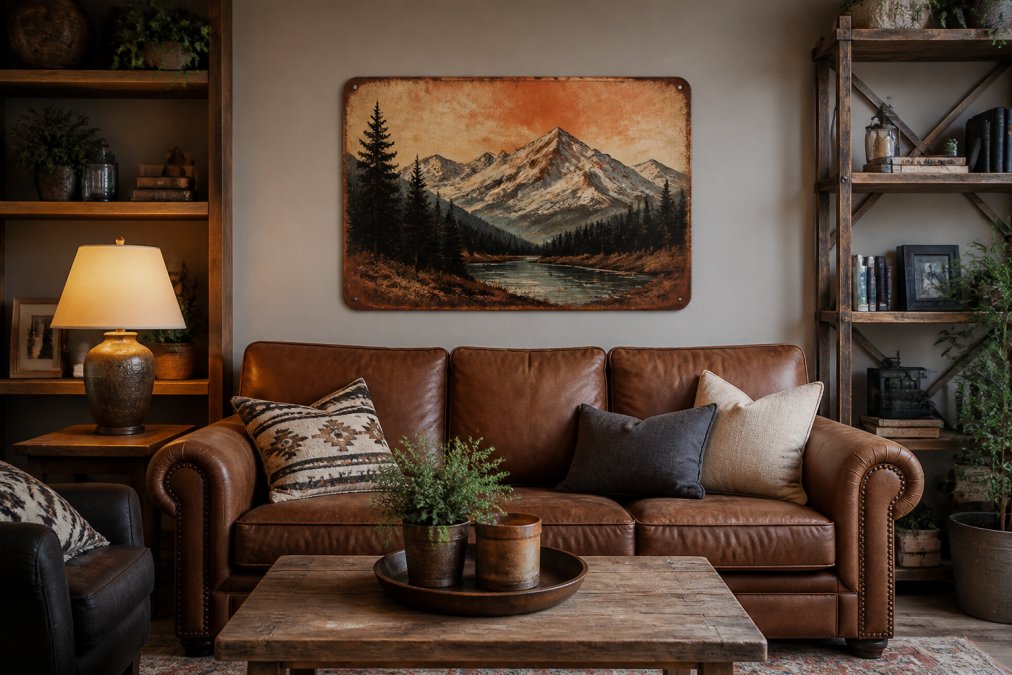
A metal sign or sculpture works as a focal point when it spans roughly two-thirds to three-quarters of the width of the furniture beneath it, a ratio that fixes most "it looks too small" complaints. For gallery walls, mix sizes rather than matching them: hang the largest piece first, centered, then build outward with a consistent gap.
Durable Aluminum Signs for Home Decor That Last
Aluminum made metal decor practical for everyday homes: lightweight enough for adhesive strips, rigid enough not to warp, and rust-free unlike steel. Real Cool Signs builds its collection around this idea, with aluminum signs in a printed vintage style that looks weathered without being weathered, the faux rust and distress are printed effects, so the surface stays smooth and structurally solid. Real Cool Signs' aluminum signs come with pre-drilled corner holes for small nails, screws, zip ties, or wall-safe adhesive strips.
Unique Gift Ideas for Car Enthusiasts and Collectors
The best gifts in this category are specific. A generic "garage" sign gets a polite nod; a sign tied to something the person actually did, drove, or collected gets hung the same day. For car and motorcycle people, look for vintage-style signage matching a specific era or model. For travelers and collectors, park and landmark signs mark a place someone has actually been.
- Road trip memories: a sign commemorating a specific park or route the person has visited
- Garage and bar walls: retro-styled aluminum pieces that hold up in a space with temperature swings
- Collector displays: matching-format signs built into a themed gallery wall over time
- Pet lovers: themed signage that names the breed or animal rather than a generic paw print
Real Cool Signs carries a National Parks collection that fits this approach, including a vintage entrance sign chart featuring 20 iconic park designs, plus individual pieces for Acadia, Grand Canyon, Yellowstone, Yosemite, Joshua Tree, Arches, Redwood, Sequoia, and Death Valley. For a niche interest, browse by theme rather than endless generic listings.

Industrial vs. Rustic Metal Decor Styles
Industrial and rustic metal decor share a material but not a mood, and mixing them carelessly is the most common styling mistake. The difference comes down to finish chemistry, hardware visibility, and what the piece says about the room.
| Style | Signature Look | Best Rooms | Watch Out For |
|---|---|---|---|
| Industrial | Exposed hardware, raw steel tones, geometric shapes | Lofts, home bars, offices | Can read cold in small spaces |
| Rustic | Weathered finish, warm earth tones, vintage typography | Cabins, kitchens, patios | Too many pieces looks themed |
| Modern minimal | Clean lines, single large-format piece | Living rooms, bedrooms | Needs open wall space |
| Vintage Americana | Faux-aged aluminum, retro typography, muted reds and creams | Garages, dens, entryways | Needs a wall with breathing room |
Industrial: Raw Metal, Visible Fasteners, Hard Geometry
Industrial leans on exposed fasteners, hard geometric shapes, and darker metal tones. It suits loft-style rooms, home bars, and offices where the architecture already has an edge, exposed brick, ductwork, concrete, or black window frames, because the art echoes the room's existing hardware rather than softening it. Industrial finishes are usually raw or clear-coated steel and iron, which develop a natural patina over time; in a humid climate, that patina can turn into surface rust if the piece isn't sealed. For the look without the maintenance, a printed faux-industrial aluminum sign gives the same visual weight with none of the oxidation risk. Real Cool Signs offers durable aluminum signs that provide a similar visual weight without the oxidation risk.
Rustic: Weathered Finishes, Warm Tones, Vintage Typography
Rustic leans on weathered finishes, warm browns and greens, and vintage-inspired artwork, a natural fit for cabins, kitchens, and covered patios. A distressed finish reads as "earned" against warm wood, stone, or brick, and softens metal's hard edges in a way polished finishes can't. The trade-off: real weathered metal, reclaimed barn tin, aged copper, rusted iron, is heavy, expensive, and often sharp-edged. Printed faux-rust aluminum delivers the same visual story at a fraction of the weight. Real Cool Signs offers durable aluminum signs that provide this visual story.
Vintage Americana: The Third Lane Most Guides Ignore
Most style breakdowns stop at industrial vs. rustic, but a third lane dominates garages, dens, and entryways: vintage Americana. Think retro service-station signage, national park entrance signs, and mid-century travel advertising, in muted reds, creams, and faded blues. This style works because it's specific, a sign tied to a route, a park, or an era the person actually knows gets hung the same day. It's also the easiest style to build into a gallery wall over time, because the format stays consistent even when the subject changes.
How to Choose Between Them
Three questions settle it fast:
- What's already on the wall? Brick, wood, and stone pull toward rustic. Concrete, black metal, and glass pull toward industrial. Painted drywall is neutral, pick based on the furniture.
- How much light does the wall get? Raw and polished metals throw glare and shadow; weathered and printed finishes absorb light. A dark hallway wants a matte or printed finish, not a mirror-polished one.
- How long do you plan to keep it? Real patina pieces age with the room. Printed finishes stay visually identical for years, which is usually what people want when they say they want "the rustic look."
If you're still torn, start with a single large-format piece matching the room's existing hardware, then build outward with smaller pieces in the same lane.
Installation and Maintenance: Hanging Metal Decor Without Damage
Hanging metal decor without damage comes down to three variables: weight, wall type, and finish.
Match the Hardware to the Wall Type
| Wall Type | Best Hardware | Avoid |
|---|---|---|
| Painted drywall | Wall-safe adhesive strips for lightweight pieces; self-drilling anchors for anything heavier | Plain nails in unsupported drywall |
| Plaster | Masonry bit to pilot the hole, then a plastic anchor and screw | Adhesive strips, plaster surfaces are often too porous or too painted to hold |
| Brick or stone | Masonry bit plus a sleeve anchor or expanding anchor | Self-drilling drywall anchors, which won't bite |
| Tile | Suction or adhesive hooks rated for the weight, or a grout-line anchor | Drilling through the tile face |
| Wood paneling or studs | Wood screws directly into the stud | Anchors, unnecessary when you've hit solid wood |
What you'll need:
- A pencil and a level
- Painter's tape for layout marking
- Wall-safe adhesive strips for lightweight pieces
- Small nails or screws and anchors for anything heavier
- A stud finder if the piece is more than a few pounds
- A soft, damp cloth for cleaning
Step-by-Step: Hanging Without Damage
Step 1: Weigh the piece and check the wall. Most aluminum signs weigh very little, opening up options heavier framed art doesn't allow. Drywall handles adhesive strips well for lightweight aluminum; plaster, brick, and tile need anchors or masonry bits. Tap the wall if you're unsure, a hollow sound means drywall, a dull thud usually means plaster or masonry.
Step 2: Mark your layout. Use the two-thirds width rule for a focal point: the piece should span roughly two-thirds to three-quarters of the width of the furniture beneath it. For gallery walls, lay everything on the floor first and photograph the arrangement from standing height.
Step 3: Use the pre-drilled holes. Most aluminum signs come with corner holes, so you can mount with screws, nails, zip ties, or adhesive strips without drilling new ones. If the holes don't line up with a stud, use two anchors instead of forcing a screw into hollow drywall.
Step 4: Level, then tighten. Tape the piece in place with painter's tape, check the level, then commit. This one habit prevents almost every crooked-hang callback.
Expected result: A level, secure piece that comes down cleanly when you move. Adhesive strips release with a slow pull downward, not a yank.
Material Durability: How Aluminum, Iron, and Copper Age
This determines whether your piece looks good in 2036.
- Aluminum resists rust naturally thanks to the oxide layer that forms on its surface. It handles humidity, covered patios, and temperature swings well, and printed finishes stay visually stable for years because the color sits on the surface rather than in a reactive metal layer.
- Iron and steel are strong and hold fine detail, but rust when moisture reaches bare metal. Indoor pieces in dry climates are usually fine. In humid or coastal areas, unsealed iron develops surface rust; a clear coat slows it but doesn't stop it forever.
- Copper and brass develop a living patina, the greenish or brownish film that forms as the metal reacts with air and moisture. Some people buy copper specifically for this; others are surprised when their shiny piece turns brown within a year.
Maintenance by Finish and Location
- Indoor, printed aluminum: Wipe with a soft damp cloth a few times a year. Skip abrasive cleaners, which dull printed finishes over time.
- Indoor, raw or polished metal: Dry-dust rather than wet-wipe. Water spots on polished steel or mirror finishes are hard to remove without polishing compound.
- Covered outdoor, aluminum: Wipe down a couple of times a year, especially after pollen season. Check that mounting hardware hasn't loosened from temperature cycling.
- Covered outdoor, iron or steel: Inspect for rust spots annually. Touch up with a matching enamel before small spots spread.
- Coastal areas: Salt air accelerates corrosion on iron and steel. Aluminum and sealed finishes hold up far better. Rinse outdoor pieces with fresh water periodically.
When to Call It a Repair vs. a Replacement
Small rust spots on iron can be sanded and touched up. Faded printed finishes usually can't be restored, the color is part of the surface, not a coating you can reapply. Loose mounting hardware is a five-minute fix. Warped or bent metal is usually permanent.
Frequently Asked Questions
Is metal wall decor still in style for 2026?
Yes. Metal wall decor remains a strong choice for 2026 because it pairs durability with design range. Layered 3D pieces, mirror-metal fusion, and weathered vintage finishes all appear in current interior design trends. Aluminum signs in particular resist fading and rust, so they work in living rooms, garages, and covered patios. A well-chosen metal piece also acts as a focal point that anchors a gallery wall or room ambiance without needing seasonal replacement.
How do I choose the right metal wall art for my living room?
Start with scale. A large-format piece works on a wide wall, while a smaller sign suits a gallery wall or shelf. Match the finish to your existing palette: industrial aesthetic favors matte black or raw steel, while rustic charm pairs well with weathered copper or distressed prints. Finally, pick a subject that matters to you, like a favorite national park or hobby theme, so the piece earns its place as a statement piece.
What are good unique gift ideas for car enthusiasts?
Vintage-style automotive signs, garage-themed aluminum prints, and custom coasters make strong gifts for car lovers. Look for durable aluminum construction with pre-drilled holes so the recipient can hang it immediately in a garage, bar, or man cave. A themed sign tied to a specific car culture, like muscle cars or classic road trips, feels more personal than a generic print and holds up better over time.
How do I hang metal wall decor without damaging walls?
Use the pre-drilled holes in your sign and mount with wall-safe adhesive strips for lightweight pieces, or screws and anchors for heavier items. For renters, adhesive strips designed for metal and a small level keep the sign straight without nails. Always check the weight rating on the strip, and clean the wall with rubbing alcohol before applying. This keeps your security deposit intact while still letting you style the space.
Will aluminum signs fade or rust outdoors?
Aluminum signs with a fade-resistant printed finish resist rust and fading when placed in covered outdoor areas like porches or patios. Direct, year-round sun and rain exposure can still wear any finish over time, so a covered spot extends the life of the piece. Wipe the surface with a soft, damp cloth to remove dust and pollen, and avoid abrasive cleaners that can dull the printed vintage effect.