


Quick Summary
Minimalist cat wall art is a clean line drawing or silhouette of a cat, placed on a simple background so it adds warmth without cluttering a modern room. Choose one strong piece in a size that covers about two-thirds of the furniture beneath it, and hang it near eye level. Its quiet design lets the cat stand out while the room stays uncluttered.
- Start with one medium print, such as 12 by 16 inches, and see how it sits in the room.
- Center the artwork roughly 57 to 60 inches from the floor, near average eye level.
- Leave 6 to 10 inches between the bottom of the frame and the top of the sofa or headboard.
- Position silhouettes near a window or lamp so light catches their edges.
- Keep paper-and-glass pieces above the height a cat can reach from its favorite perch.
Table of Contents
- Why Minimalist Cat Wall Art Suits Modern Homes
- Minimalist Cat Line Drawing Prints for Clean Walls
- Modern Cat Silhouette Wall Art and Shadow Play
- Large Minimalist Cat Wall Art for Modern Homes
- Matching Colors, Frames and Materials to Your Interior
- How to Hang Cat Wall Art at the Right Height and Spacing
- Budget-Friendly Versus Investment Cat Art Pieces
- Choose Your First Cat Piece for Your Modern Space
- Frequently Asked Questions
Last Updated: November 2, 2026
Minimalist cat wall art has become one of the easiest ways to bring personality into a modern home without cluttering it. Real Cool Signs designs sign collections around the things people love, and cats are a favorite subject for many enthusiasts. The pieces that work best in contemporary rooms tend to share a few traits: clean lines, plenty of open space, and a single strong subject. Browse our cat-themed sign designs for ideas that fit these qualities.

This guide walks through how to choose, style, hang, and budget for minimalist cat wall art. Along the way, we'll point out where a few of our own pieces fit naturally into the picture.
Why Minimalist Cat Wall Art Suits Modern Homes
Modern interiors favor restraint. Neutral palettes, straight edges, and open wall space are the norm, and busy artwork can feel out of place in those rooms. Minimalist cat art fits because a simple silhouette or line drawing adds warmth without competing with furniture or architecture.
Cats also carry a lot of visual character in very few strokes. A single curled tail or a sharp ear profile can say more than a detailed painting. That's why the style has grown alongside Scandinavian and industrial interiors, where designers favor one or two statement pieces over a crowded gallery wall.
Minimalist Cat Line Drawing Prints for Clean Walls
Line drawing prints are often the easiest entry point. They work in bedrooms, hallways, kitchens, and home offices, and they rarely clash with existing decor. A single black ink outline on white or cream paper reads as contemporary even in a traditional room.
A typical approach is to start with one print in a medium size, such as 12 by 16 inches, and see how it sits in the room before adding more. Many homeowners find that one well-placed print does more than three smaller ones scattered around.
Choosing Line Weight and Negative Space
Line weight changes the mood of a print. Thin, delicate strokes feel airy and suit bedrooms or nurseries. Bolder lines carry more presence and work better in living rooms or entryways. Pay attention to negative space too: the empty area around the cat is part of the design. A print with generous white space looks more intentional on a large wall, while a tightly cropped drawing can feel more dramatic in a smaller alcove.
Modern Cat Silhouette Wall Art and Shadow Play
Silhouettes bring a different kind of drama. A solid black cat shape reads clearly from across a room, and it creates strong contrast against light walls. Silhouette art is especially effective where light changes through the day, because shadows shift and the piece looks slightly different morning to evening.
Placement matters here. Position silhouettes near a window or beside a lamp so the light catches the edges. Pieces with a matte finish reduce glare and keep the shape readable in bright sun. Many people find that a dimmer, warmer bulb brings out the depth in a metal or wood silhouette more than a bright overhead light does.
The Types of Cats Sign is a good example of how a cat-themed piece can carry strong visual interest without heavy decoration. Its vintage natural history chart style pairs well with modern rooms when you want a bit more detail than a silhouette offers. It is available in 8" x 12" and 12" x 18" sizes at $27.99.
Large Minimalist Cat Wall Art for Modern Homes
Oversized pieces suit open-plan spaces, tall walls, and rooms with high ceilings. A large print above a sofa or bed can anchor the entire room. The challenge is proportion: a piece that's too small for its wall looks lost, while one that's too large can overwhelm a compact room.
As a rough guide, many designers suggest the artwork should cover about two-thirds of the width of the furniture beneath it. That rule of thumb is a starting point, not a requirement, so adjust based on what looks balanced in your space.
Sizing a piece to its wall and furniture is easier to judge with a quick reference:
| Guideline | Value | Note |
|---|---|---|
| Artwork width vs. furniture below | About two-thirds | A starting point, not a requirement |
| Center height from floor | 57 to 60 inches | Near average eye level |
| Gap above sofa or headboard | 6 to 10 inches | Keeps the piece connected to the room |
| Spacing between grouped frames | 2 to 3 inches | Keep it consistent |
| Lowest frame above cat perch | At least 12 inches | Applies to gallery walls with furniture cats use |
Matching Colors, Frames and Materials to Your Interior
Color is the simplest lever to pull, but the choices run deeper than most guides admit. Black and white cat art is versatile because it works with almost any palette, and it is also the default for a reason: in pet-friendly homes, high-contrast monochrome reads cleanly against fur, scratches, and the everyday wear that comes with animals. If you prefer color, pick one accent tone already present in the room, a cushion, rug, or plant, and echo it in the artwork or frame rather than introducing a new hue.
Frames: Match the Finish, Not the Trend
Frames and materials should match the rest of the room's finishes. Thin black metal frames suit contemporary spaces and disappear against dark walls. Natural wood frames warm up minimalist rooms that lean toward neutrals. A common pattern among designers is to repeat a finish already used elsewhere in the room, the same black as a lamp base, the same oak as a side table, so the frame feels intentional rather than purchased separately.
Watch out: a heavy ornate frame will fight a minimalist print every time. If the artwork is a single line drawing, the frame should be quiet enough that the line is the first thing the eye finds.
Materials and Sustainability
Material choice matters to many modern homeowners. If sustainability is a priority, check what paper and inks a print uses before you buy.
Metal signs and aluminum prints bring a different texture, with a clean, slightly reflective surface that reads modern without feeling cold. A matte finish can reduce glare and keep the image readable in bright light.
Print Quality Trade-Offs
A useful rule is to spend on the piece you will look at every day and save on the pieces that fill out a grouping. Giclée prints on cotton rag paper offer rich detail, while metal and wood pieces bring a different texture and feel. Neither is universally better, the choice comes down to the look and feel you want for the space.
How to Hang Cat Wall Art at the Right Height and Spacing
Hanging height is where many well-chosen pieces lose their impact. A common guideline is to center the artwork at roughly 57 to 60 inches from the floor, which is near average eye level. When art hangs above furniture, leave about 6 to 10 inches between the bottom of the frame and the top of the sofa or headboard so the piece feels connected to the room rather than floating.
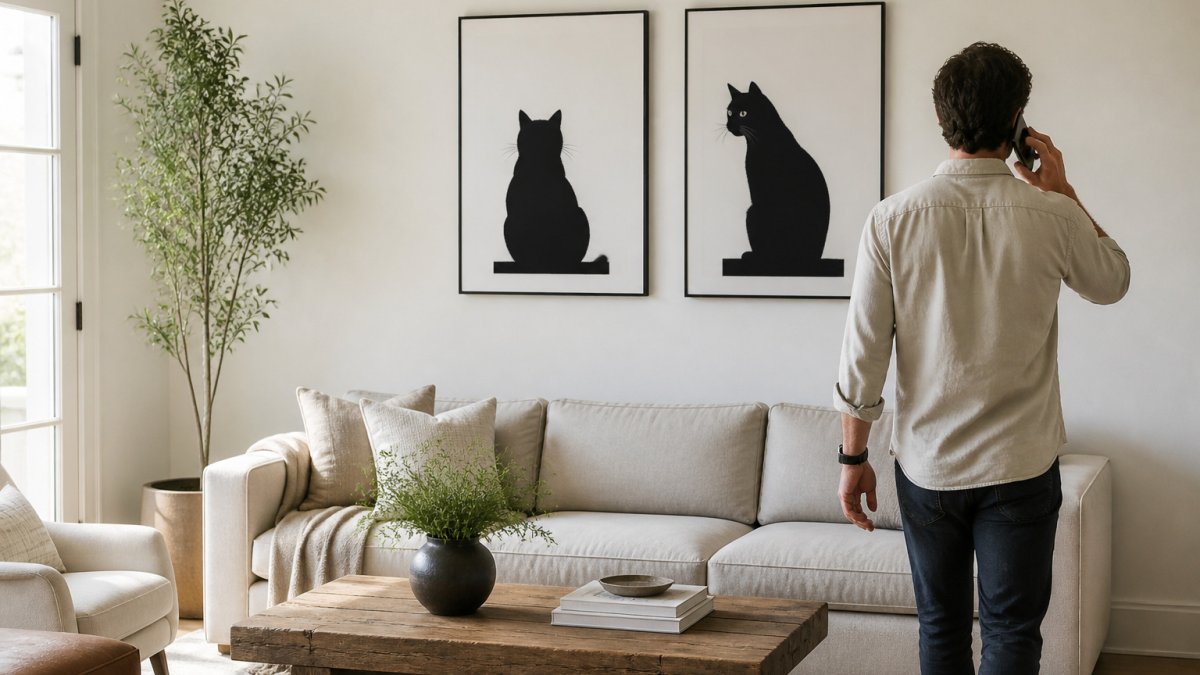
For groupings, keep spacing consistent, usually 2 to 3 inches between frames. Lay pieces out on the floor first, or tape paper templates to the wall, before you drive any nails. Use a level, and mark your hanging points lightly in pencil. Renters can use removable hanging strips or picture hooks rated for the frame's weight, check the package weight rating before you hang anything heavier than a small print.
Lighting and Shadow Play: The Missing Ingredient
Most guides stop at height and spacing, but the piece that makes a minimalist cat print feel truly modern is the light hitting it. Silhouettes and line drawings are essentially studies in contrast, and the way a room is lit changes how much of that contrast the eye actually sees.
A few practical patterns are worth knowing. First, avoid placing a silhouette directly across from a bare window that receives harsh afternoon sun; the glare washes out the shape and flattens the piece. Second, a warm, dimmable bulb on a side table or floor lamp positioned to graze the artwork from the side will pull out texture and edge detail that a flat overhead light hides. Third, if you have a picture light, aim it slightly downward rather than straight on, the angled wash creates a soft shadow beneath the frame that reads as depth.
Watch out: a glossy frame or glass under a direct spotlight will throw a hot spot that competes with the artwork. Matte finishes and anti-glare glass solve this, and they matter more in a room with a cat, where you may also be cleaning nose prints off the surface.
Hanging Around a Cat's Reality
A detail the styling guides skip: cats climb. A framed print hung low on a wall near a sofa back or a shelf is an invitation. Keep paper-and-glass pieces above the height a cat can reach from its favorite perch, and reserve lower spots for metal or wood pieces that can take a bump. If you are building a gallery wall, anchor the heaviest piece at the top and keep the lowest frame at least 12 inches above any furniture a cat uses as a launch pad.
Budget-Friendly Versus Investment Cat Art Pieces
Not every piece needs a large budget. A reasonable approach is to mix price points. Buy one or two higher-quality focal pieces, then add smaller, lower-cost prints to fill out the arrangement. This keeps the room feeling curated instead of purchased all at once.
Investment-level pieces usually offer better materials, finishes, and longevity. Budget options can still look polished if they're sized correctly and framed well. The Warning Siamese Cat Sign, priced at $27.99 and available in 8" x 12" and 12" x 18" sizes, is an example of an accessible piece that works on a shelf, entryway, or accent wall. Its distressed, vintage-inspired finish adds character for those who want something with more texture than a clean print.
Choose Your First Cat Piece for Your Modern Space
Start with one piece in the room where you spend the most time, usually the living room or bedroom. Choose a size that fills roughly two-thirds of the wall or furniture beneath it, decide between line art and silhouette based on the light you have, and hang it at a comfortable eye level.
Once that first piece feels right, adding a second or third becomes much easier. Many cat lovers begin with a Types of Cats Sign for a hallway and later add a silhouette for the bedroom, building a collection that reflects their own love of felines. If you're ready to choose, consider the Warning Siamese Cat Sign as a concrete first piece. Explore the cat-themed options at Real Cool Signs and find the piece that fits your space and your story.

Frequently Asked Questions
What styles of minimalist cat wall art work best in modern homes?
Line drawings with clean outlines, black and white silhouettes and simple contemporary portraits fit most modern interiors best. They rely on negative space rather than color or pattern, so they sit comfortably beside sleek furniture and neutral walls. Single-subject prints usually look more intentional than busy compositions. A Types of Cats Sign from Real Cool Signs, priced at $27.99 in the 8 by 12 inch size, shows how a vintage-style chart can still read as clean decor when the layout stays simple.
What size wall art works best above a sofa?
As a general guide, art above a sofa should span roughly two-thirds to three-quarters of the sofa's width, and it should sit about 8 to 10 inches above the backrest. A single large print often works better than several small ones in a minimalist room. For a narrow wall, a tall 12 by 18 inch piece can balance the space without crowding it. Measure the wall first and tape the outline on the wall before you commit to a hole.
How can you display several cat prints without making a wall feel cluttered?
Keep the frames consistent in color and material, and leave generous spacing between pieces, often 2 to 3 inches. Arrange prints in a straight row or a symmetrical grid rather than a scattered collage. Limiting the wall to two or three pieces keeps the focus on each image. Repeating one line weight or one color across the set ties the group together without adding visual noise.
Where should you hang cat art in a living room?
Place cat art where it can be seen from the main seating area, such as above a console table, along a hallway, or on a wall facing the sofa. Avoid hanging it where glare from a window hits the glass. Eye level for the center of the artwork, roughly 57 to 60 inches from the floor, is a common starting point in galleries. Adjust based on your ceiling height and furniture.
