


Table of Contents
- Step 1: Pick the Focal Point and Set Your Budget
- Step 2: Choose Man Cave Wall Art That Matches Your Palette
- Step 3: Add Custom Metal Signs for Home Bar and Hobby Walls
- Step 4: Tools and Mounting Hardware for a Clean Install
- Step 5: Best Practices for Gallery Walls and Spatial Arrangement
- Step 6: DIY Personalization on a Budget
- Step 7: Protect Your Wall Art: Maintenance and Preservation
- Common Mistakes to Avoid
- Frequently Asked Questions
Last Updated: September 15, 2026
Step 1: Pick the Focal Point and Set Your Budget
The focal point for your man cave wall art is the wall your eye lands on the moment you walk in. Pick it before you buy a single piece. In most man caves, that's the wall behind the bar, the TV, or the main seating area.
A common mistake is treating every wall equally. You end up with four competing displays and no visual anchor. Choose one hero wall, then let the other walls support it with smaller decorative accents.
Budget matters here too. Decide whether you're building this in one weekend or over a few months. Spreading purchases out lets you wait for sales and avoid panic buys that never quite fit.
Step 2: Choose Man Cave Wall Art That Matches Your Palette
Your color palette decides whether the room feels like a sanctuary or a storage unit. Start with what's already there: wall color, flooring, furniture, and any lighting effects you've installed. The goal is not to repaint the room around the art, it's to pull colors that already exist and repeat them on the wall.
Pull a Palette From the Room You Already Have
Before you buy anything, gather three reference points:
- The dominant fixed color. This is usually the wall paint or the largest piece of furniture. Write down its closest match.
- The secondary fixed color. Flooring, a bar top, or a leather couch. This is your anchor tone.
- One existing accent. A lamp shade, a throw pillow, a rug pattern, or a neon sign. This becomes the color you echo in the art.
Most people find they already own two of the three colors and only need to introduce one. That single new color is where your art does its work.
Color Palettes That Work in a Man Cave
- Industrial style: charcoal, rust, aged brass, and concrete gray
- Retro: burnt orange, teal, cream, and mustard yellow
- Automotive: black, chrome silver, racing red, and deep navy
- Rustic bar: walnut brown, amber, forest green, and warm cream
- Garage workshop: safety yellow, gunmetal, white, and matte black
Stick to three core colors and one accent. When every piece shares that palette, the room reads as intentional rather than collected.
The 60-30-10 Rule, Applied to a Man Cave
A common interior design pattern is the 60-30-10 split: roughly 60 percent of the visual weight in a dominant color, 30 percent in a secondary, and 10 percent in an accent. In a man cave, the walls and large furniture usually carry the 60. Mid-size pieces, a bar sign, a shelf, a rug, carry the 30. The 10 is where you get to be loud: a bright accent sign, a colored frame, or a single bold graphic.
If you skip the 10 entirely, the room feels flat. If you flip it and make the accent the loudest thing on every wall, the room feels chaotic. The ratio is the mechanism that keeps it balanced.
Matching Art to Furniture and Texture
Texture does as much work as color. A smooth aluminum sign next to rough reclaimed wood creates contrast that flat prints can't match. If your furniture is sleek and modern, lean toward clean graphics and glossy finishes. If it's worn leather and dark wood, vintage memorabilia and distressed finishes fit right in.
A practical test: photograph your wall and the piece you're considering, then view both in grayscale. If the piece still reads as distinct from the wall in grayscale, it has enough value contrast to hold the space. If it disappears, it's too close in tone no matter how well the colors match.
Lighting Changes Everything
Warm Edison bulbs push every color toward yellow-orange. Cool white LEDs push them toward blue. A sign that looks perfect in daylight can look muddy under a warm bulb. If you're buying a piece for a specific wall, check it under the actual light source that wall receives, not under the store's overhead lighting.
Matching Art to Furniture and Texture
Texture does as much work as color. A smooth aluminum sign next to rough reclaimed wood creates contrast that flat prints can't match. If your furniture is sleek and modern, lean toward clean graphics. If it's worn leather and dark wood, vintage memorabilia and distressed finishes fit right in.
Step 3: Add Custom Metal Signs for Home Bar and Hobby Walls
Custom metal signs are the fastest way to stamp your personality on a man cave. They handle the text, the name, and the theme in one piece, so you don't need ten small prints to tell your story.
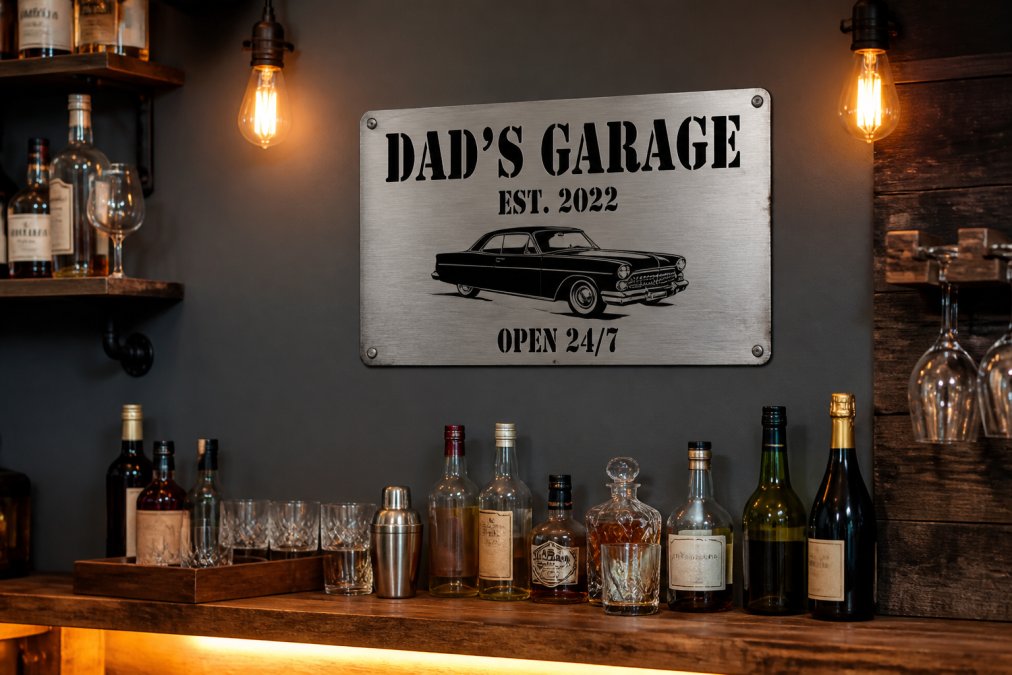
For a home bar, personalized beer, cola, or tiki bar signs set the tone instantly. A Custom Name Garage Sign works just as well over a workbench or tool wall, and it's built from durable aluminum with a sublimated graphic finish.


Personalizing Text, Names, and Imagery
The rule is simple: one custom element per wall. Add your name, your nickname, or your bar's made-up name. Then let the imagery carry the theme, whether that's a vintage car, a favorite pet, or a hobby you've sunk years into.
Step 4: Tools and Mounting Hardware for a Clean Install
A crooked sign ruins an otherwise great wall. Get the hardware right before you drill anything.
What you'll need:
- Tape measure and a spirit level
- Pencil for marking
- Stud finder
- Screws and wall anchors rated for your wall type
- Painter's tape for test placement
Most aluminum signs come with pre-drilled 1/4" screw holes, which makes alignment straightforward. For drywall without a stud, use hollow-wall anchors rated for the weight. For brick or concrete, switch to masonry bits and sleeve anchors.
Step 5: Best Practices for Gallery Walls and Spatial Arrangement
A gallery wall is a group of pieces arranged as one unit. Get the spacing right and it looks curated. Rush it and it looks like a yard sale. The difference comes down to three decisions: the layout pattern, the hanging height, and the spacing between pieces.
Pick a Layout Pattern Before You Drill
Most successful gallery walls follow one of four patterns:
- Grid: equal-size frames in even rows and columns. Best for uniform prints or a series. Easiest to hang, hardest to make interesting.
- Salon style: mixed sizes filling a defined rectangle, edge to edge. Best for a large focal wall with many pieces.
- Centered row: one horizontal line of pieces at the same height. Best above a bar, console, or TV.
- Organic cluster: pieces arranged around one anchor piece, spreading outward. Best when you have one hero sign and several smaller supporting items.
For a man cave, the centered row and organic cluster tend to work best because they let a single custom sign anchor the composition instead of competing with it.
The 2/3 Rule and Sizing Wall Art
A useful guideline: artwork should cover roughly two-thirds of the width of the furniture beneath it. A 60-inch console pairs well with a display about 40 inches wide.
Hanging Height: The 57-Inch Rule
Template the Layout on the Floor First
DIY vs. Professional Printing
Material Trade-Offs for Gallery Walls
Step 6: DIY Personalization on a Budget
Step 7: Protect Your Wall Art: Maintenance and Preservation
Common Mistakes to Avoid
Frequently Asked Questions
What is the 2/3 rule for wall art?
The 2/3 rule says your wall art should span about two-thirds the width of the furniture beneath it, like a sofa or bar counter. A 60-inch console calls for art roughly 40 inches wide. For man cave wall art, this keeps a gallery wall or single statement piece from looking lost or oversized, and it gives the room a visual anchor instead of a scattered arrangement.
What colors work best for decorating a man cave?
Dark bases like charcoal, navy, and deep green make a room feel like a hangout space, while warm accents (amber, rust, cream) add contrast without turning it into a showroom. Build a three-color palette: one dominant wall color, one furniture tone, and one accent pulled from your art. That accent is where a retro sign or vintage memorabilia print earns its place.
What materials hold up best for durable man cave signs?
Aluminum is the practical pick for a man cave or patio. It resists rust and fading better than tin or acrylic, handles humidity from a home bar, and stays light enough to hang with basic mounting hardware. A sublimated graphic on aluminum keeps colors sharp over time, which matters if the sign sits near a window or gets direct light.
How do I balance custom art with existing man cave decor?
Treat existing pieces as the base layer, then add one or two personalized items as the visual anchor. If your room already leans industrial style, a custom metal sign fits without fighting the room. If it is heavy on vintage memorabilia, keep new pieces in the same color palette so the wall reads as one collection, not a pile of unrelated finds.