


Table of Contents
- What You'll Need Before You Hang Metal Signs Without Damaging Walls
- Damage-Free Hanging Solutions for Metal Art
- Heavy-Duty Command Strips for Metal Signs: Step-by-Step
- Magnetic Hanging Systems for Metal Signs
- Hanging Metal Signs on Drywall Without Nails
- Removal and Residue Management: How to Take Down Metal Signs Cleanly
- Environmental Factors That Affect Your Hanging Method
- Conclusion: Hang Metal Signs Without Damaging Walls the Smart Way
Last Updated: August 1, 2026
Knowing how to hang metal signs without damaging walls is one of those skills that sounds simple until you're standing there with a beautiful aluminum piece in one hand and a landlord's security deposit on the line. This guide from Real Cool Signs covers every method, material, and mistake worth knowing, so you can display your favorite signs with confidence.
Here's what most guides get wrong: they treat all metal signs as if they weigh the same and all walls as if they're identical. The right approach depends on your sign's weight, your wall's surface, and whether you want a temporary or permanent installation.
What You'll Need Before You Hang Metal Signs Without Damaging Walls
Total Time: 30-60 minutes Difficulty: Beginner to Intermediate
Before anything touches your wall, gather your supplies. Rushing this step is how people end up with crooked signs, damaged surfaces, or worse, a sign that crashes to the floor at 2 a.m.
Essential supplies checklist:
- Isopropyl alcohol (70% or higher) for surface preparation
- Clean microfiber cloth
- Measuring tape and pencil
- Level (a small torpedo level works great)
- Heavy-duty adhesive strips or mounting tape rated for your sign's weight
- Mounting hardware appropriate to your wall type
- Optional: suction cups, magnetic hooks, or cable suspension system
Assessing Your Sign's Weight and Material
Damage-free hanging solutions for metal art start with knowing exactly what you're hanging. Aluminum signs, like those in the Real Cool Signs collection, are lightweight relative to their size, which makes them excellent candidates for adhesive-based mounting. A small 8x12-inch aluminum sign typically weighs well under a pound.
Weigh your sign on a kitchen scale before choosing your mounting method. This single step determines everything: which adhesive strips to buy, how many anchor points you need, and whether you can skip hardware entirely.
Quick weight-to-adhesive reference:
| Sign Weight | Recommended Method | Anchor Points Needed |
|---|---|---|
| Under 1 lb | Standard adhesive strips | 2 points |
| 1-3 lbs | Heavy-duty adhesive strips | 4 points |
| 3-5 lbs | Heavy-duty strips + mounting bracket | 4-6 points |
| Over 5 lbs | Hardware or cable suspension | Professional assessment |
Surface Preparation and Cleaning
Surface preparation is the step everyone skips and then blames the product for failing. Adhesive strips bond to clean, dry, smooth surfaces. Dust, grease, or residue will cut your adhesive's tensile strength significantly.
Clean the wall surface with isopropyl alcohol on a microfiber cloth. Wipe in one direction, not in circles. Let it dry completely, at least 60 seconds. Do the same for the back of the sign. This two-surface prep approach is what separates a strip that holds for years from one that fails in a week.
Damage-Free Hanging Solutions for Metal Art
Damage-free hanging solutions for metal art span at least five distinct categories, and the best choice depends on your specific situation.
Temporary vs. Permanent Installation: Choosing the Right Approach
Temporary installation is the right call if you're renting, redecorating frequently, or testing a layout before committing. Permanent installation makes sense for homeowners who know exactly where they want a piece to live for years.
Temporary options include adhesive strips, suction cups, magnetic hooks, and removable mounting tape. Permanent options include traditional nails, screws with wall anchors, and cable suspension systems. For most aluminum signs, a temporary solution is all you need due to their lightweight nature.
Rental-Friendly Solutions That Protect Your Security Deposit
Renters face a specific challenge: they want to personalize their space without losing money when they leave. According to Consumer Financial Protection Bureau renter rights resources, security deposit disputes are among the most common landlord-tenant conflicts.
The best rental-friendly methods are:
- Peel-and-stick adhesive strips rated for your sign's weight, removed at 45 degrees per manufacturer instructions
- Tension rod systems for signs with grommets or hanging holes
- Magnetic mounting on metal surfaces like refrigerators or metal doors
- Suction cups on tile, glass, or smooth painted surfaces
- Over-door hooks for signs near doorways
None of these require drilling or will cost you your deposit.
Heavy-Duty Command Strips for Metal Signs: Step-by-Step
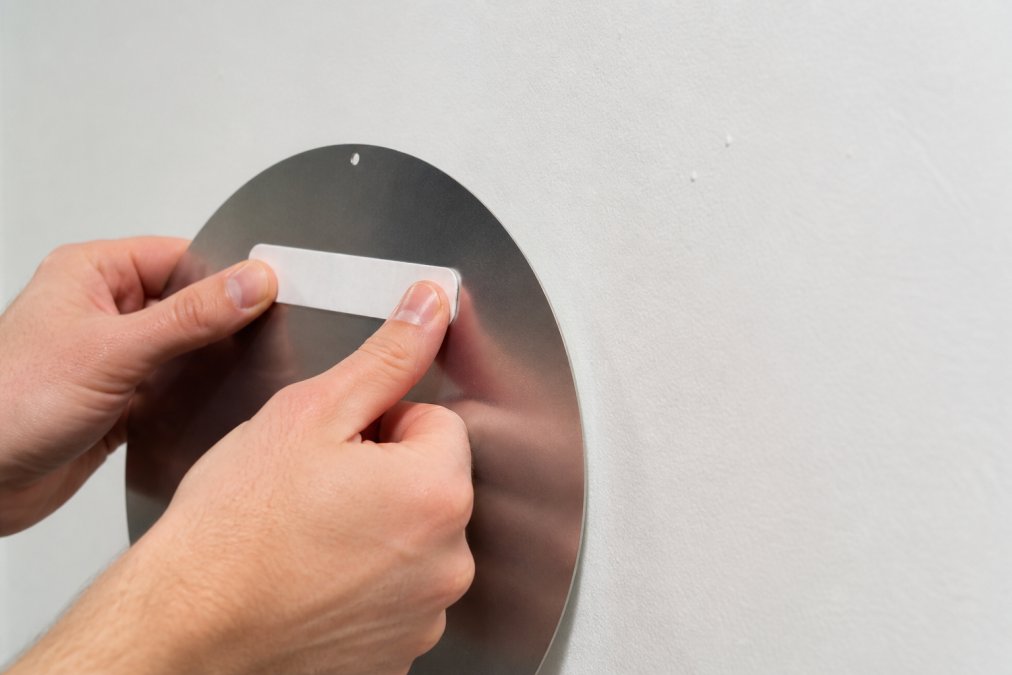
Heavy-duty command strips for metal signs are the most popular non-destructive mounting method. After cleaning both surfaces with isopropyl alcohol and allowing them to dry, follow these steps:
- Separate the strip sets. Each pair has a wall side and a sign side.
- Press the strips together to activate the interlocking adhesive layers.
- Apply to the sign first. Press firmly for 30 seconds on each strip.
- Mark your wall placement with a pencil using a level for alignment.
- Press the sign to the wall at your marked position. Apply firm, even pressure for 30 seconds.
- Remove the sign by pulling the release tab, leaving the wall-side strips in place.
- Wait the full cure time, typically one hour per manufacturer instructions.
- Rehang the sign by pressing it back onto the wall-mounted strips.
Weight Capacity Considerations and the Weight-to-Adhesive Ratio
A practical rule: use strips with a combined rating of at least twice your sign's actual weight. A 2-pound sign should have strips rated for at least 4 pounds combined. This buffer accounts for wall texture imperfections and humidity fluctuations.
Wall texture matters enormously. Smooth painted drywall gives adhesive strips near-maximum performance. Textured surfaces reduce effective bonding area. On textured walls, increase your strip count by 50%.
Common Mistakes to Avoid with Adhesive Strips
Applying strips in cold temperatures is a common mistake. Adhesive products need warmth to bond properly. If your wall surface is below 50°F, the adhesive will never cure to full strength.
Other frequent errors include not waiting the full cure time before loading the sign, applying over fresh paint, using strips on wallpaper without adjusting quantity, and overloading strips by hanging multiple items from the same set.
Magnetic Hanging Systems for Metal Signs
What's the actual advantage of magnetic mounting over adhesive strips? Repositionability. You can move the sign without any residue, waiting, or wall contact.
Magnetic systems work in two configurations. The first uses strong rare-earth magnets on existing metal surfaces like steel doors or metal cabinets. The second uses a magnetic base plate adhered to the wall, with a corresponding magnetic layer on the sign back.
For aluminum signs specifically, note that aluminum is not inherently magnetic. You'll need a magnetic backing plate attached to the sign or a system that uses adhesive on the sign side and magnetic on the wall side.
Magnetic systems shine in garages, workshops, and commercial spaces where metal surfaces are common.
Using Suction Cups for Smooth Surfaces
Suction cups are the most underrated mounting solution for smooth surfaces. On glass, glazed tile, polished metal, and smooth painted surfaces, a quality suction cup with a locking lever mechanism can hold several pounds indefinitely.
The key word is "smooth." Suction cups fail on any surface with texture because they can't form an airtight seal. Test the surface by pressing the cup firmly and waiting 10 minutes before loading the sign.
For bathroom tile, kitchen backsplash, or large windows, suction cups let you hang metal signs without damaging walls or touching the wall surface with adhesive.
Hanging Metal Signs on Drywall Without Nails
Drywall is the most common wall surface in American homes and the most forgiving for non-destructive mounting. Hanging metal signs on drywall without nails is entirely achievable for most sign weights using adhesive methods.
The one situation where you genuinely need hardware: signs over 5 pounds on drywall. At that weight, adhesive strips become unreliable over time, especially in humid environments.
Cable and Wire Suspension Systems
Cable suspension systems are the professional-grade solution for hanging metal signs without damaging walls beyond a single anchor point. A picture rail, ceiling hook, or single wall anchor at the top supports a wire or cable that drops down to hold the sign from above.
This method distributes the sign's weight through tension rather than direct wall contact. It also allows easy repositioning by sliding the sign along the cable.
For signs with pre-drilled holes or grommets, cable systems are particularly elegant. Thread the cable through the holes, adjust the height, and the sign hangs level without any contact with the wall surface below.
Mounting Brackets and Fence Clips for Outdoor Surfaces
Outdoor mounting introduces environmental variables that indoor installation doesn't face. Wind load, temperature cycling, UV exposure, and moisture all affect how well any mounting system performs.
For outdoor fences, gates, and walls, fence clips and zip ties are the non-destructive standard. They thread through sign holes and attach to fence wire or lattice without requiring any drilling. For masonry or brick outdoor walls, adhesive solutions designed for exterior use are the better call.
Real Cool Signs aluminum signs are built for outdoor durability, which means the sign itself won't be the weak point. The mounting method is what you need to get right for long-term outdoor display.
Removal and Residue Management: How to Take Down Metal Signs Cleanly
Getting a sign up is only half the job. Getting it down without leaving a mess is where the real skill shows.
For adhesive strips: stretch the tab slowly at a low angle, parallel to the wall. Go slow. If the strip tears, use dental floss or a credit card edge to work under the remaining adhesive from the sides.
For residue left behind: isopropyl alcohol removes most adhesive residue from painted walls without damaging the paint. Apply to a cloth, not directly to the wall, and rub gently. For stubborn residue, a small amount of cooking oil applied for 5 minutes before wiping often works better than solvents.
For suction cup marks on glass or tile: a standard glass cleaner removes any residue immediately.
The most important rule for clean removal: never rush it. Slow, steady tension removes adhesive strips cleanly.
Environmental Factors That Affect Your Hanging Method
Environmental factors are the variable that causes unexpected failures months later.
Humidity is the biggest threat to adhesive mounting. High humidity, common in bathrooms, kitchens, and basements, causes adhesive strips to lose grip over time. In high-humidity spaces, use twice the recommended strip count or choose mechanical mounting.
Temperature cycling affects outdoor installations most severely. Adhesive that works perfectly in summer may fail in winter as surfaces contract and expand.
Direct sunlight degrades many adhesive products over time. UV exposure breaks down the adhesive compound, which is why outdoor-rated adhesive products use different formulations than indoor ones. Always check whether your chosen adhesive is rated for UV exposure if the sign will be in direct sun.
Vibration matters in garages, workshops, and near HVAC equipment. Constant low-level vibration slowly works adhesive loose. In these environments, mechanical fasteners or cable suspension systems are more reliable.
Matching your mounting method to your actual environment is what separates a sign that stays put for years from one that needs remounting frequently.
Conclusion: Hang Metal Signs Without Damaging Walls the Smart Way
The throughline across every method covered here is the same: match your mounting approach to your specific combination of sign weight, wall surface, environment, and permanence goals.
Knowing how to hang metal signs without damaging walls comes down to preparation, the right adhesive or hardware for the job, and patience during both installation and removal. Lightweight aluminum signs give you the most flexibility because their low weight opens up every non-destructive option available.
For renters especially, the methods here mean you can fully personalize your space without worrying about what happens when you move. Heavy-duty adhesive strips, suction cups, magnetic systems, and cable suspension all let you display signage you're proud of without touching your security deposit.
Ready to make your space stand out? Explore unique, conversation-starting signs at RealCoolSigns.com and find the perfect piece for your home, office, garage, or gift.
Frequently Asked Questions
What is the best way to hang a metal sign without nails?
The best way to hang metal signs without nails depends on the sign's weight. For lightweight aluminum signs, heavy-duty adhesive strips or peel-and-stick mounting tape are reliable, non-destructive options. For heavier pieces, a cable suspension system or magnetic hooks anchored to a mounting rail work well. Always clean the wall surface with isopropyl alcohol first to maximize adhesion. These methods let you hang metal signs without damaging walls and are ideal for renters or anyone wanting a damage-free installation.
Do Command Strips work on metal signs?
Yes, heavy-duty Command Strips can work on metal signs, provided the sign's weight falls within the product's stated load-bearing limit. Most heavy-duty adhesive strips handle several pounds per pair. For aluminum signs, which are naturally lightweight, Command Strips are often a perfect fit. The key is proper surface preparation: wipe both the wall and the sign's back with isopropyl alcohol, let both dry completely, then apply firm pressure for at least 30 seconds. Always check the tensile strength rating on the packaging before hanging.
Can you hang metal signs with magnets?
Magnetic hanging systems for metal signs work well in specific situations. If your wall has a metal surface, such as a steel panel, a magnetic whiteboard, or a metal garage door, strong neodymium magnetic hooks can hold aluminum signs securely without any fasteners or adhesive. For standard drywall, you'd need to pair magnetic hooks with a metal mounting strip adhered to the wall first. This is a popular rental-friendly solution since the mounting strip can be removed cleanly using damage-free adhesive backing.
How do you hang metal art on drywall without drilling?
Hanging metal signs on drywall without nails or drilling comes down to matching the right non-destructive method to your sign's weight. Lightweight aluminum signs work great with heavy-duty adhesive strips or double-sided mounting tape. Medium-weight pieces can use cable and wire suspension systems attached to picture rail molding if available. Always prepare the drywall surface by wiping it with isopropyl alcohol to remove dust and oils. Avoid textured drywall surfaces for adhesive methods, as surface texture significantly reduces adhesive contact and tensile strength.
Is it safe to hang metal signs in outdoor or humid environments?
Environmental factors matter when choosing your hanging method. Outdoor patios, garages, and humid spaces can weaken standard adhesive strips over time. For outdoor use, look for weatherproof mounting hardware or heavy-duty exterior-rated adhesive strips. Aluminum signs are naturally rust-resistant, making them a durable choice for outdoor display. However, your fasteners and mounting hardware should also be rust-resistant. In very hot climates, adhesive strips can soften and lose grip, so mechanical options like fence clips or cable suspension systems are safer long-term choices.
How do I remove metal signs hung with adhesive strips without damaging the wall?
Removing adhesive strips cleanly is straightforward when done correctly. Most heavy-duty strips have a pull tab, stretch it slowly at a low angle parallel to the wall rather than pulling straight out. This releases the adhesive gradually without tearing drywall paper. If residue remains, a small amount of isopropyl alcohol on a soft cloth usually dissolves it without harming paint. Never yank the sign away from the wall first; always remove the sign gently, then address the strip separately. This protects both wall integrity and your security deposit.
Ready to make your space stand out? Explore unique, conversation-starting signs at RealCoolSigns.com and find the perfect piece for your home, office, garage, or gift.