


Table of Contents
- Why Durable Outdoor Metal Signs Transform Your Patio
- Materials That Actually Last: Aluminum vs. Steel vs. Tin
- How to Protect Outdoor Metal Signs From Rust
- Mounting Metal Signs on Brick or Wood Surfaces
- Vintage and Rustic Styles That Work Year-Round
- Sizing Your Metal Sign for Small and Large Patios
- Maintenance and Longevity: Keeping Your Sign Looking New
- Conclusion
Last Updated: August 6, 2026
Why Durable Outdoor Metal Signs Transform Your Patio 🏡
Your patio is an extension of who you are. It's where you entertain, unwind, and showcase your personality. But here's the thing most homeowners get wrong: they treat patio decor like an afterthought. They grab whatever's on sale, hang it up, and hope it lasts through the first winter.
That's where durable outdoor metal signs come in. These aren't your grandmother's decorative plaques. Modern outdoor metal signs are engineered to withstand UV rays, temperature swings, humidity, and the occasional storm. They're also deeply personal, you can display your passions, your sense of humor, or your love for gardening without apologizing for it.
At Real Cool Signs, we've seen firsthand how the right metal sign transforms a blank patio wall into a conversation starter. Whether you're mounting a vintage orchard sign above your garden beds or hanging a custom piece that reflects your lifestyle, the durability factor matters more than most people realize. A sign that fades after one season isn't decor, it's a waste of money.
The real benefit? Once you understand the materials, finishes, and installation techniques, you can confidently choose a sign that'll look sharp for years. This guide breaks down exactly what makes a metal sign last, how to protect it from rust, and how to install it properly so it stays put through whatever weather comes your way.
Materials That Actually Last: Aluminum vs. Steel vs. Tin 🔧
Not all metals are created equal when it comes to outdoor durability. The material you choose determines how long your sign will hold up and how much maintenance it'll need. Let's cut through the noise and look at what actually works.
Powder-Coated Steel and 16-Gauge Construction
Steel is the workhorse of outdoor metal signs. When manufacturers use 16-gauge (approximately 1.8mm thick) cold-rolled steel with an industrial powder coating, you're looking at serious durability. The gauge matters, thinner steel flexes and dents more easily, while 16-gauge provides rigidity that keeps your sign flat and true.
Powder coating is the game-changer here. It's a dry finishing process that creates a hard, protective shell around the steel. Unlike paint, which can chip and peel, powder coating bonds at a molecular level. It resists scratches, UV fading, and corrosion far better than traditional paint.
The trade-off? Steel is heavier than aluminum, so mounting requires proper hardware and sometimes professional installation on certain surfaces. But that weight also means your sign won't rattle in the wind or shift over time.
Aluminum and UV-Resistant Finishes
Aluminum is lighter, naturally rust-proof, and increasingly popular for outdoor metal signs. Here's why: aluminum doesn't corrode the way steel does because it doesn't contain iron. It's also easier to cut into intricate shapes, which makes custom designs more feasible.
The catch? Bare aluminum can oxidize and develop a dull, chalky surface over time. That's why quality aluminum signs use UV-resistant inks and often include a clear protective laminate or coating. This laminate acts like a shield against sun damage, keeping colors vibrant and preventing fading.
Aluminum signs work especially well in coastal or high-humidity environments where salt spray would destroy steel. They're also ideal if you want a lighter-weight option that's easier to install yourself.
How to Protect Outdoor Metal Signs From Rust 🛡️
Rust is the enemy of outdoor metal signs, but it's preventable. Understanding how rust forms and what stops it is half the battle.
Rust happens when iron (in steel) reacts with oxygen and moisture. The powder coating on quality steel signs acts as a barrier that keeps moisture away from the metal underneath. But if that coating gets scratched or damaged, rust can start creeping in from that weak point.
Here's what actually works to keep rust at bay:
Inspect regularly. Walk around your patio every month or two. Look for scratches, chips, or areas where the coating might be wearing thin. Catching damage early means you can touch it up before rust takes hold.
Clean gently. Use a soft cloth and mild soap with water. Avoid abrasive scrubbers or harsh chemicals that can strip the protective coating. Rinse thoroughly and dry with a soft cloth to prevent water spots.
Touch up damage immediately. If you spot a scratch or chip, use a rust-preventative touch-up paint designed for outdoor metal. This stops rust from forming at that spot. Most hardware stores carry these products specifically for metal signs and outdoor gear.
Avoid prolonged moisture. If your sign collects water in a pocket or corner, that's a rust hotspot. Position your sign so water drains away naturally. In areas with heavy rain or snow, consider adding a slight angle to the mounting.
Use proper hardware. Stainless steel bolts, brackets, and fasteners won't rust themselves and won't stain your sign. Cheap hardware can rust and leave streaks on your beautiful sign. Always upgrade to stainless.
Mounting Metal Signs on Brick or Wood Surfaces 🔨
Installation is where most people either nail it or create a disaster. Mounting on brick and wood require different approaches, but both are totally doable if you know the basics.
Tools and Hardware You'll Need
Before you start, gather the right gear. A power drill with a masonry bit (for brick) or standard bits (for wood) is essential. You'll also need a level, trust me, a crooked sign looks worse than no sign at all.
For brick, you'll need masonry anchors or concrete screws. These are designed to bite into brick and hold tight. For wood, standard lag bolts or exterior-grade wood screws work well, but always use stainless steel to prevent rust stains.
A stud finder is helpful if you're mounting on a wood fence or wall, you want to hit solid wood, not just the surface. A tape measure, pencil, and drill bit that matches your anchor or screw diameter round out the toolkit.
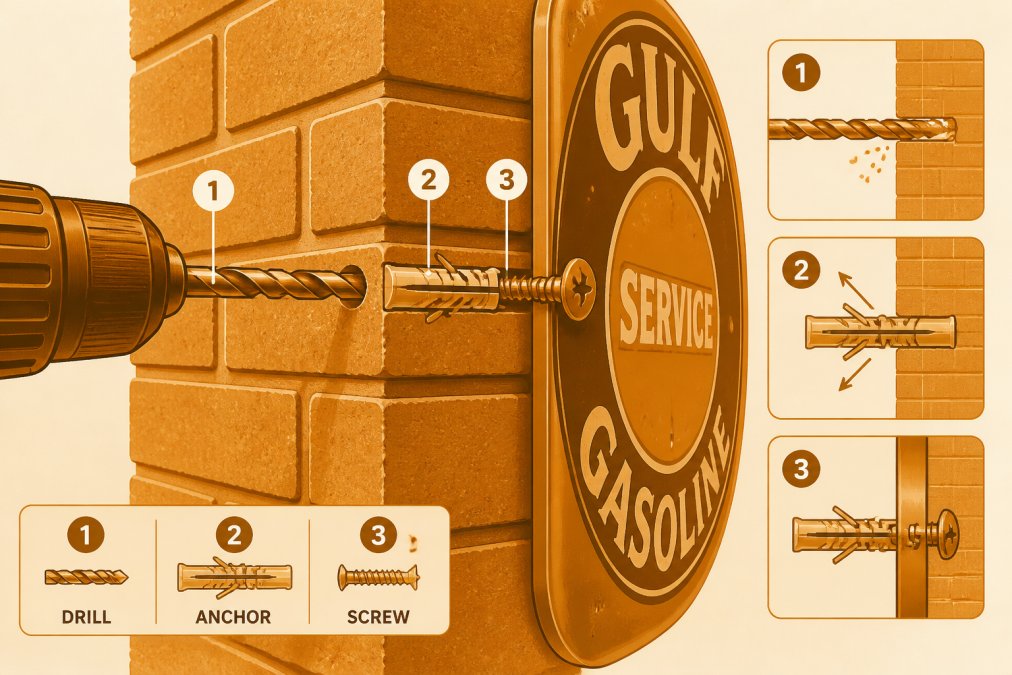
Step-by-Step Installation on Different Surfaces
Mounting on brick:
- Mark your hole locations with a pencil, using a level to ensure they're straight.
- Drill pilot holes using a masonry bit. Go slow, brick can crack if you rush.
- Insert masonry anchors into the holes. Tap them gently with a hammer until they're flush with the brick surface.
- Attach your mounting bracket or bolt through the anchor. Tighten firmly but don't overtighten, you can crack the brick.
- Hang your sign and double-check that it's level.
Mounting on wood:
- Find solid wood by using a stud finder or tapping with a hammer (solid wood sounds different than hollow).
- Mark your holes with a pencil and level.
- Drill pilot holes slightly smaller than your bolt or screw diameter.
- Insert stainless steel bolts or screws and tighten until snug. Again, don't overtighten, you can strip the wood.
- Hang your sign and verify it's level.
The key difference: brick needs anchors to distribute the weight, while wood can take bolts directly. Both surfaces can support a heavy metal sign if you use the right hardware.
Vintage and Rustic Styles That Work Year-Round 🌾
Vintage and rustic metal signs have staying power because they tap into something real, nostalgia, authenticity, and a connection to simpler times. These styles don't go out of fashion because they're not trendy. They're timeless.
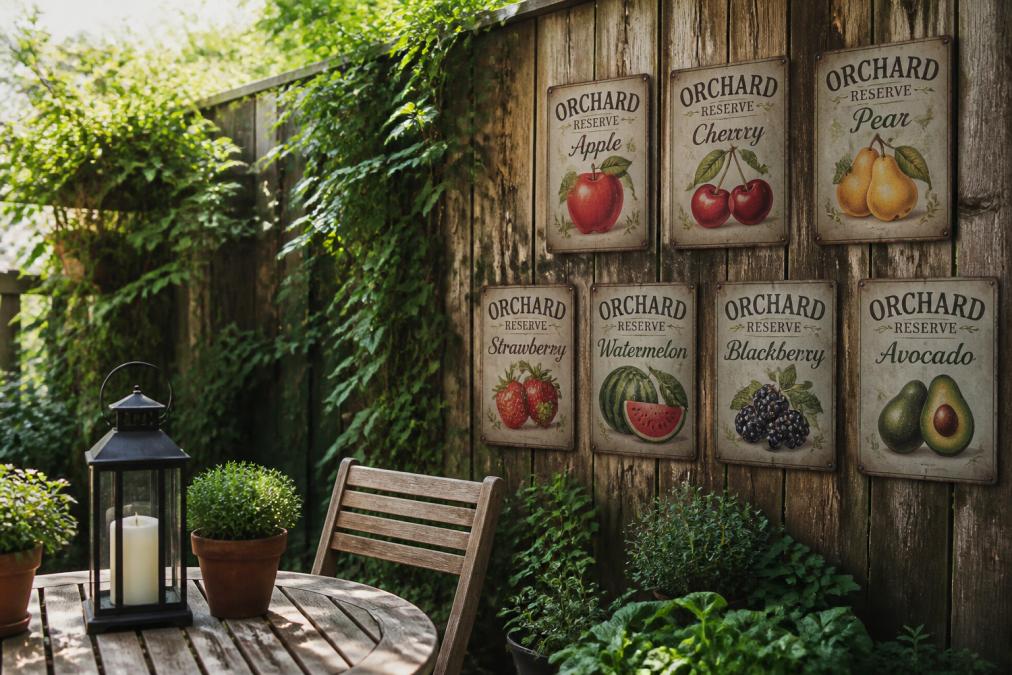
Farmhouse aesthetics have exploded in popularity, and for good reason. A vintage orchard sign, think "Apple Orchard Reserve" or "Pear Orchard Reserve", brings warmth and character to any outdoor space. These signs work whether your patio is modern, traditional, or somewhere in between.

Real Cool Signs offers a collection of vintage orchard designs that capture that authentic farmhouse vibe. The Vintage Apple Orchard Reserve Sign features classic typography and a weathered finish that looks like it's been hanging in a country kitchen for decades. Same goes for the Vintage Pear Orchard Reserve Sign and Vintage Strawberry Orchard Reserve Sign, each one brings its own charm to your patio.


What makes these signs work year-round is their simplicity. They don't rely on trends or seasonal colors. A vintage orchard sign looks equally at home in summer, fall, winter, and spring. The aesthetic is stable, which means you're not constantly updating your decor.
Sizing Your Metal Sign for Small and Large Patios 📏
Size matters more than most people think. A sign that's too small gets lost on a big wall. A sign that's too large overwhelms a tiny patio. Get the scale right, and your sign becomes a focal point. Get it wrong, and it looks awkward.
For small patios (under 100 square feet), aim for signs in the 12" to 18" range. These sizes are visible from across the space without dominating it. A 12" x 18" vintage orchard sign, for example, draws the eye without making your patio feel cramped.
Medium patios (100-300 square feet) can handle 18" to 24" signs. This is the sweet spot for most residential spaces. Your sign is prominent enough to be a real design element, but not so large that it screams for attention.
Large patios (over 300 square feet) can go bigger. 24" to 36" signs work well here, especially if you're mounting them on a large wall or fence. The extra size commands the space without looking out of proportion.
A practical rule: measure the wall or fence section where you're mounting. Your sign should take up roughly 30-40% of that space. If your wall is 4 feet wide, a 18-24" sign hits that target perfectly.
| Patio Size | Recommended Sign Size | Best Placement |
|---|---|---|
| Small (under 100 sq ft) | 12" - 18" | Entry wall, fence section |
| Medium (100-300 sq ft) | 18" - 24" | Main wall, focal point |
| Large (over 300 sq ft) | 24" - 36" | Large wall, garden backdrop |
Maintenance and Longevity: Keeping Your Sign Looking New ✨
A quality metal sign can last 10-15 years or longer if you treat it right. That's a solid return on your investment. Here's the maintenance playbook that keeps signs looking sharp.
Seasonal cleaning is your best friend. Twice a year, spring and fall, give your sign a thorough but gentle cleaning. Use a soft cloth, mild dish soap, and lukewarm water. Rinse completely and dry with a microfiber cloth to prevent water spots.
In harsh environments, coastal areas with salt spray, or regions with heavy snow and ice, inspect your sign more frequently. Salt spray can accelerate corrosion even on powder-coated steel, so rinse your sign with fresh water after salt exposure. Snow and ice can trap moisture, so brush off snow promptly and allow the sign to dry fully.
UV fading is inevitable over time, but quality finishes slow it dramatically. UV-resistant inks and protective coatings are worth the investment because they keep your sign looking vibrant for years longer than budget options.
Check your mounting hardware annually. Bolts can loosen over time from wind vibration or temperature changes. A quick tightening keeps your sign secure and prevents it from shifting or falling.
If you notice rust spots (rare on quality signs, but possible if hardware fails), address them immediately. Use a wire brush to gently remove surface rust, then apply a rust-preventative paint. This stops rust from spreading.
The bottom line: a few minutes of maintenance twice a year keeps your sign looking like it did the day you installed it. Neglect it, and even a quality sign will show its age.
Frequently Asked Questions
How do you keep metal signs from rusting outside?
The best defense against rust is choosing powder-coated steel or aluminum with UV-resistant finishes. These materials create a protective barrier that prevents moisture from reaching the metal underneath. For added protection, apply a clear coat sealant annually and rinse your sign with fresh water after heavy rain or salt exposure. Store signs indoors during extreme winter months if possible, and inspect mounting hardware regularly to ensure fasteners aren't corroding.
Are aluminum signs good for outdoor use?
Yes, aluminum is excellent for outdoor metal signs because it naturally resists rust and corrosion. Unlike steel, aluminum doesn't require the same level of maintenance and won't develop rust spots over time. Look for aluminum signs with UV-resistant inks and lamination to prevent fading. Aluminum is lighter than steel, making installation easier, and it's ideal for coastal areas or humid climates where rust is a concern.
What size metal sign should I choose for my patio?
For small patios under 100 square feet, signs 12 to 18 inches work best without overwhelming the space. Medium patios benefit from 24 to 30-inch signs, while large patios can accommodate 36-inch or larger pieces as focal points. Consider viewing distance: signs meant to be read from across the yard need larger lettering. Measure your wall or fence space first, then choose a sign that fills about one-third of that area for balanced visual impact.
How do I mount a metal sign on brick or wood?
For brick, use concrete anchors and lag bolts drilled into mortar joints rather than brick itself. For wood, pre-drill holes and use corrosion-resistant screws or bolts with washers. Always use stainless steel or galvanized hardware to prevent rust. Ensure your mounting hardware matches the sign's weight, and use a level during installation. Most metal signs come pre-drilled; if yours doesn't, space holes at least 12 inches apart for stability.
Ready to make your space stand out? Explore unique, conversation-starting signs at RealCoolSigns.com and find the perfect piece for your home, office, garage, or gift.